What Is Nail Sickness?
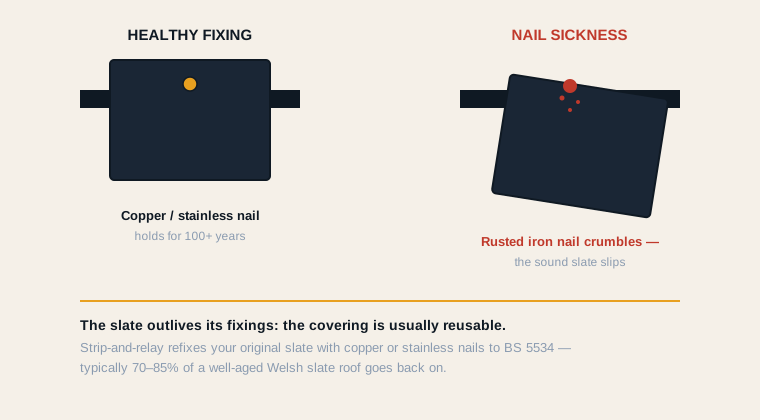
Nail sickness is the corrosion of the ferrous (iron or mild steel) nails used to fix roof tiles to the battens beneath them. When these nails corrode sufficiently, they lose their grip on the tile. The tile can then slide down the roof slope under its own weight — initially a millimetre or two, eventually falling off entirely or sitting at an angle that allows water ingress.
It is called “sickness” because it spreads: if the nails on one part of your roof are failing, the nails elsewhere were installed at the same time in the same conditions and are corroding at a similar rate. Nail sickness is a whole-roof problem, not a spot problem.
The nails used to fix concrete interlocking tiles on Oxford’s post-war estates were typically mild steel — adequate for the time, but with a service life of 40–60 years in the Oxfordshire climate. Properties built between 1950 and 1980 that haven’t had a re-roof are now entering the peak nail sickness period.
Which Oxford Properties Are Most at Risk?
The highest concentration of nail sickness in Oxford is on the post-war and 1960s–1970s concrete tile estates:
Across our Oxford surveys, post-war estate properties over 60 years old show widespread nail movement in the large majority of cases, based on our own field data 2025. — Source: own field data 2025
- Barton and Risinghurst — 1960s system-built and conventional construction, almost entirely concrete interlocking tiles now 55–65 years old
- Blackbird Leys — Oxford’s largest post-war estate, 1950s–1970s construction, widespread nail sickness throughout
- Rose Hill and Florence Park — 1930s–1950s stock, the later builds on concrete tile now at risk
- Parts of Cowley and Marston — mixed era, post-war sections heavily affected
- Didcot — large post-war town, Northbourne and Ladygrove estates predominantly 1950s–1970s concrete tile
- Bicester — earlier post-war stock (pre-modern estate expansion) showing widespread nail failure
- Kidlington — Moors estate and post-war sections affected
Note: Victorian and Edwardian properties in Jericho, North Oxford and Headington are largely not affected by nail sickness because clay plain tiles were fixed differently and often with copper nails. Their equivalent failure mode is ridge mortar failure and lead flashing deterioration.
How to Spot Nail Sickness from the Ground
You don’t need to get on the roof to spot the early signs. From the pavement with binoculars or a camera with optical zoom, look for:
- Tiles sitting proud or at an angle relative to adjacent tiles — a tile that has slipped 5–20mm down is often visible as a shadow line or step in an otherwise even course
- Tiles that are slightly rotated — the nail holds one side while the other side drops, creating a diagonal misalignment
- Missing tiles — a tile that has fully slipped will eventually fall. Missing tiles in an otherwise intact roof on a property of this era are a strong nail sickness indicator
- Uneven tile lines — courses that were perfectly straight when laid become wavy as multiple tiles shift independently
- Daylight through the eaves — if tiles have slipped at the bottom course, you may see daylight through the overhang at eaves level
What a Professional Survey Shows
A roofing survey for nail sickness involves getting onto the roof and pressing on individual tiles to test their fixing. A well-nailed tile is rigid. A nail-sick tile moves under hand pressure, rocking or sliding. We typically check a sample of 20–30 tiles across all elevations and report on the percentage that move. This gives an objective basis for advising repair versus replacement.
We also check whether water has been entering through slipped tiles. In Oxford’s older properties, lath-and-plaster ceilings absorb and spread water readily — a small nail sickness ingress over two or three winters can cause significant plaster damage that isn’t obvious until the ceiling fails.
Repair or Replace?
If fewer than 10–15% of tiles show movement, individual re-nailing and replacement of missing tiles buys 5–10 more years at a fraction of re-roofing cost. If 20%+ of tiles show movement, a full re-tile is the right answer — re-nailing individual tiles on a deck where the majority of nails are corroding is a temporary fix that will need repeating within a few years.
When re-tiling for nail sickness we use stainless steel or aluminium nails throughout. These will outlast the tiles themselves and eliminate the recurrence of the problem.
Think your roof may have nail sickness? We carry out free surveys across Oxford and Oxfordshire. We’ll give you an honest assessment of extent and a clear recommendation. Call 0186 580 3181.
Related: Roof Tiling Oxford · Roof Replacement Oxford · Roof Repairs Oxford