Quick answer: Lead roofing on Oxford's period properties uses Code 4 lead for flashings and Code 5 for valleys and parapet gutters. Original Victorian lead is 100–130 years old and past its 50–80 year life. Silicone repairs fail within two seasons; permanent re-dressing is the correct fix.
Why Lead Matters in Oxford
Lead is the invisible jointing material that makes every Oxford roof weathertight at the critical junctions: chimney stack to surrounding tiles, two roof slopes at a valley, roof meeting a parapet wall. On Oxford's Victorian and Edwardian stock — where original lead is now 100–130 years old — lead failure is the single most common cause of active roof leaks.
Where Lead Is Used
Chimney Flashings
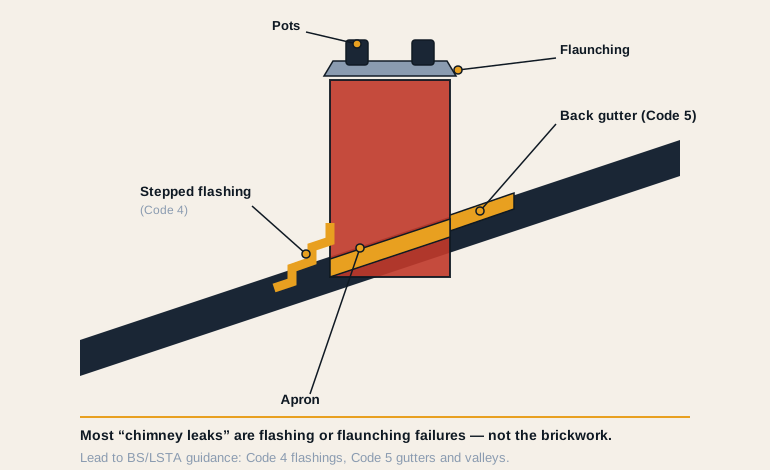
Every chimney stack requires lead step flashings on both sides, a back gutter at the upslope junction, and soakers between each tile course and the brickwork. This is the most commonly failing lead application on Oxford properties. The step flashing upstand is dressed into a raked mortar joint — thermal cycling over decades pulls it away from the joint, creating a gap through which water tracks behind the stack. The ceiling stain appears offset from the chimney as water follows the roof timbers.
British Standard BS EN 12588 defines the rolled lead sheet codes, with Code 4 (1.8mm) for flashings and Code 5 (2.24mm) for valleys and parapet gutters. — Source: British Standard BS EN 12588
Valley Linings
Where two roof slopes meet in a valley, a lead lining forms the waterproof joint. Code 5 lead is specified for valley linings because of the water volume in heavy rainfall. Valley lead failure produces a leak directly below the valley line at ceiling level.
Parapet Gutters
The largest Edwardian villas in North Oxford and Summertown have concealed lead-lined gutters behind stone or brick parapets. When these fail, water penetrates at parapet level and tracks down through the building fabric — often undetected for years before causing visible staining. Access requires scaffold to parapet level.
Why Lead Fails
Lead has a high coefficient of thermal expansion. UK summer-to-winter temperature ranges cause significant cyclical movement. Over decades, this movement works the lead upstand away from its fixing point — pulling it out of a raked mortar joint, separating it from an adjacent flashing, or splitting it at a fixed point. Correct installation accounts for this movement: lead is fixed at one end only, with the free end sliding over the adjacent material. Incorrect installation creates stress points where cyclical movement concentrates and leads to failure.
Why Silicone Doesn't Work
Silicone sealant is frequently applied to failing lead flashings as a quick fix. It bonds initially and bridges the gap. But lead's thermal movement breaks the bond within one or two seasons. The gap reopens and the silicone seal fails — and silicone bonded to the brickwork makes proper lead repair more difficult. We do not carry out silicone repairs on lead work. The correct repair is re-dressing the lead upstand into a freshly raked mortar joint, or replacing the lead section where it has split.
Lead Code Specification
Lead is sold in standard thickness codes. Code 4 (1.8mm) for flashings and soakers. Code 5 (2.24mm) for valley linings, parapet gutters and flat roof covering. Using the correct code is essential — under-specified lead fails faster and is not compliant with BS EN 12588 or Lead Sheet Association guidelines.
Patination Oil on Period Properties
New lead has a bright silver appearance. On period Oxford properties with clay tile or Welsh slate, this can be conspicuous until weathered. We apply patination oil to new lead work on conservation area and period properties — it promotes rapid weathering to a natural grey and prevents white carbonate staining on surrounding tiles.
Lead failure on your Oxford property? Free survey. We assess all lead work and provide a written quote for permanent repair. Call 0186 580 3181.
Related: Lead Work Oxford · Chimney Repairs · Victorian Roofing Guide · Roofers North Oxford