Mechanical dry verge and dry ridge systems across Oxford's post-war estates: mortar-free caps that end recurring verge and ridge mortar failure for good. BS 8612 compliant, 10-year guarantee.
Quick answer: Dry verge in Oxford costs £250–£600 per gable, with dry ridge from £400–£900. These mechanical mortar-free systems permanently fix the recurring verge and ridge mortar failure common on Oxford's 1960s–80s concrete tile estates. They meet British Standard BS 8612, mandatory for new verges since 2018.
✓ NFRC Registered
✓ Fully Insured
✓ 10-Year Guarantee
✓ Free Quotes
✓ No Hidden Costs
The System
Dry Verge and Dry Ridge Explained
Traditional verges and ridges were bedded in mortar, which cracks, erodes and fails over 20–40 years — leaving loose tiles, water ingress and a repeating repair bill. Dry verge and dry ridge systems replace the mortar with mechanical interlocking caps and clips, fixed to the tiles and battens without any mortar. Once fitted, they do not need repointing again — ending the recurring failure permanently. Dry verge caps the gable (sloping) edges; dry ridge secures the apex tiles.
Since the 2018 revision of BS 5534, mechanical fixing to BS 8612 is effectively mandatory for new verge work, making dry verge the current standard rather than an upgrade.
Oxford Estates
Dry Verge on Oxford's Post-War Estates
Named 1960s–80s Estates
Oxford's large post-war concrete-tile estates are the core market for dry verge: Blackbird Leys (1950s–70s), Barton and Risinghurst (1960s), the Littlemore and Rose Hill post-war sections, and the surrounding Didcot and Bicester estate stock. These properties were built with mortar-bedded verges and ridges now 50–70 years old and failing. Dry verge conversion during re-tiling, or as a standalone upgrade, ends the recurring mortar problem for good.
Wind Funnelling and Elevation
The elevated, exposed positions of the Barton and Risinghurst estates — 80–100m on the eastern hills — expose gable verges to higher wind loading than valley properties. Mortar-bedded verges on these estates fail faster, and dry verge's mechanical fixing is particularly valuable here, holding the verge tiles securely against the wind that loosens mortar-bedded edges.
The End of the Repointing Cycle
For an Oxford homeowner on a post-war estate, the appeal of dry verge is simple: it ends the cycle of paying to re-bed and repoint verges and ridges every couple of decades. The mechanical caps are UV-stable, weatherproof and maintenance-free once fitted. On estates like Blackbird Leys where whole streets share the same ageing mortar, dry verge is the sensible long-term answer.
Fitted During Re-Tiling or Standalone
Dry verge and dry ridge are most economically fitted during a re-tile, when the verge and ridge are already being worked, but we also fit them as standalone upgrades where the roof covering is otherwise sound. We assess which approach suits your Oxford property at the survey.
Dry Verge Pricing
Dry Verge & Dry Ridge Costs
Dry verge (per gable)£250–£600
Ridge re-bed (traditional)£200–£500
Dry ridge (full run)£400–£900
Dry verge + dry ridge combinedPriced per property
Fitted during re-tileReduced combined cost
BS 8612 compliantStandard
Dry verge is priced per gable and dry ridge per run. Fitting both during a re-tile is the most economical approach as the verge and ridge are already being worked. Standalone upgrades are quoted after survey. All work meets BS 8612 and carries our 10-year guarantee.
Ending the Repointing Cycle for Good
Why Dry Verge Is Now the Standard
For an Oxford homeowner on one of the city's post-war estates, dry verge answers a specific and familiar frustration: the verge and ridge mortar that keeps failing and keeps costing money to repoint. Mortar-bedded verges and ridges were standard on the 1960s to 1980s concrete-tile estates — Blackbird Leys, Barton, Risinghurst, Littlemore and the surrounding Didcot and Bicester stock — and that mortar has a limited life. It cracks, erodes and lets go, leaving loose tiles at the gable edge and along the ridge, and every time it is repointed the clock simply starts again. Dry verge breaks that cycle permanently by replacing the mortar with mechanical caps and clips that never need repointing. The mechanical advantage matters most on Oxford's exposed estates. Barton and Risinghurst sit at eighty to a hundred metres on the eastern hills, and their gable verges take far higher wind loading than sheltered valley properties. Mortar-bedded verges on these estates fail faster because the wind works at the weakened mortar and lifts the edge tiles. Dry verge caps are mechanically fixed to the tiles and battens, so they hold firm against exactly the wind loading that loosens mortar — which is why the benefit is greatest precisely where the problem is worst. The same applies to the exposed Wantage and Didcot properties that face open country. There is also a regulatory dimension that has made dry verge the default rather than an upgrade. The 2018 revision of BS 5534, the code of practice for slating and tiling, effectively made mechanical fixing to BS 8612 mandatory for new verge work — recognising that mortar alone is no longer considered adequate to hold verge tiles against modern wind-load expectations. So when we fit dry verge on an Oxford property, we are not adding a premium extra; we are meeting the current standard. The most economical time to fit it is during a re-tile, when the verge and ridge are already exposed, but we also fit it as a standalone upgrade where the covering is otherwise sound. Either way, it is the last time those verges will ever need attention.
Dry verge and dry ridge systems are covered by British Standard BS 8612, and mechanical fixing of verges became effectively mandatory following the 2018 revision of BS 5534, the code of practice for slating and tiling.— Source: British Standard BS 8612
Tired of repointing failing verges? Book a dry verge survey for your Oxford home.
"Verges on our Blackbird Leys semi had been repointed twice and failed again. Dry verge caps fitted — no more mortar, no more loose tiles. Should have done it years ago."
Trevor S. · Blackbird Leys
★★★★★
"Exposed Risinghurst house, the wind kept loosening the verge mortar. Mechanical dry verge holds firm now. Fitted it with the re-tile so it worked out cost-effective."
Denise M. · Risinghurst
★★★★★
"Dry ridge and verge on our Barton semi during the re-roof. Explained BS 8612 and why mortar's no longer the standard. Solid, maintenance-free finish."
Alan W. · Barton
Common Questions
Frequently Asked Questions
Dry verge costs £250–£600 per gable and dry ridge £400–£900 for a full run. Fitting both during a re-tile is the most economical approach. All work meets BS 8612 and carries our 10-year guarantee.
Dry verge replaces mortar-bedded gable edges with mechanical interlocking caps fixed to the tiles and battens. Unlike mortar, which cracks and fails over 20–40 years, dry verge never needs repointing — ending the recurring verge failure permanently.
Oxford's post-war concrete-tile estates — Blackbird Leys, Barton, Risinghurst, Littlemore and the Rose Hill post-war sections — where mortar-bedded verges are now 50–70 years old and failing. The exposed Barton and Risinghurst estates benefit particularly from mechanical fixing.
Since the 2018 revision of BS 5534, mechanical fixing to BS 8612 is effectively mandatory for new verge work. This makes dry verge the current standard rather than an optional upgrade for new and replacement verges.
Yes. Dry verge and dry ridge are most economically fitted during a re-tile, but we also fit them as standalone upgrades where the roof covering is otherwise sound. We assess which approach suits your property at the survey.
No. Once fitted, dry verge and dry ridge caps are UV-stable, weatherproof and maintenance-free. Unlike mortar, they do not need repointing, ending the recurring repair cycle for the lifetime of the roof covering.
The elevated, exposed positions of estates like Barton and Risinghurst expose gable verges to higher wind loading, which loosens mortar-bedded edges faster than on sheltered valley properties. Mechanical dry verge holds the tiles securely against this wind.
A full re-roof is a major spend, and an honest roofer will tell you when you do not yet need one. It becomes the right call when repairs stop holding or the covering has reached the end of its service life across the whole roof.
Tiles lifting by hand across the roof (widespread nail sickness)
Repeated leaks appearing in different places after each repair
Sagging or dipping in the roof line seen from the street
Widespread slipped or delaminating slates on a Victorian or Edwardian property
A covering visibly past its age — brittle concrete tile, crumbling mortar throughout
When it is not the answer: If the failure is contained to one slope or a single area, a targeted repair is far cheaper — do not let anyone sell you a full re-roof for an isolated problem. Read the full guide.
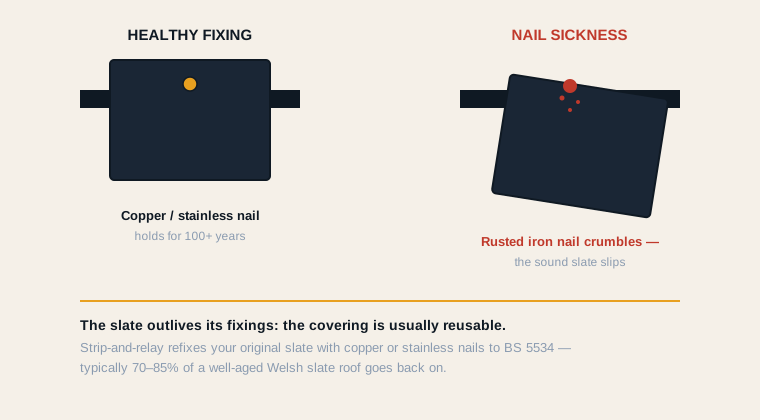
Nail sickness: the slate outlives its fixings, so the covering is often reusable.The process
How a Oxford Roof Replacement Job Runs
1. Survey & measure
We measure the roof, assess the timbers and confirm material requirements — including any conservation matching for your Oxford property.
2. Written itemised quote
A fixed-price quote covering scaffold, strip, disposal, membrane, battens, covering and the guarantee, with VAT status confirmed in writing.
3. Scheduling & materials
We schedule the re-roof, typically within 2–4 weeks, allowing lead time for matched clay or slate where a conservation area requires it.
4. Scaffold & strip
Scaffold goes up, the old covering is stripped to the timbers, and the deck is inspected before anything new is laid.
5. Re-cover & sign-off
New membrane, battens and covering are laid with stainless fixings; we clear all waste and issue the 10-year guarantee.
Sustained rain or high wind pauses a strip-off; we only open up what we can make weathertight by the end of the working day.
Access
Scaffold, Skips & Street Access
A full re-roof always needs scaffold for safe access and to move materials — it is included as a line item in the quote. Scaffold is specified for: the whole job — a re-roof is never done without full scaffold - always itemised in your written quote, never a hidden extra, and we arrange it.
Central Oxford's medieval street core and the tight Victorian terraces of Jericho and off the Cowley Road mean rear-access scaffold and permit-controlled pavement space are the norm on many jobs. Pavement scaffold and skip permits go through Oxford City Council; allow a few working days on streets like Holywell Street, Ship Street, St Michael's Street, Merton Street where space is tight.
Pricing
Oxford Roof Replacement: Cost Guide
Job
Typical range
Notes
2-bed terrace re-roof
£5,500–£8,500
Concrete or clay, incl. scaffold
3-bed semi re-roof
£8,000–£13,000
Covering-dependent
Detached / larger property
£12,000–£20,000+
Size & material driven
Welsh slate re-roof (period)
£14,000–£28,000+
Matched natural slate
Timber / structural repairs
£300–£1,500
If found on strip
What moves the price
Roof size, pitch and number of slopes
Covering: concrete tile, clay, or natural slate
Scaffold scale and duration
Conservation constraints on materials in Oxford's protected areas
Condition of timbers found once stripped
Worked example: A full concrete-tile re-roof on a 3-bed semi in Cowley, including scaffold, strip, new membrane, battens and covering, typically lands around £10,500.
Staged payments on re-roofs against completed work — never a large sum before materials are on site. Written fixed-price quote with VAT stated.
Covering OX1, OX2, OX3, OX4 and surrounding postcodes.
Guarantee
Your Guarantee, Explained
The full re-roof carries a 10-year written workmanship guarantee; the covering and membrane carry their own manufacturer warranties, often 15–30 years, on top.
Covered: workmanship for 10 years, in writing, transferable if you sell.
On top: manufacturer warranties on materials (terms vary by product).
Not covered: storm or impact damage - that is an insurance matter, and we will document it for your claim.
If a fault appears in covered work, we come back and put it right. No quibbling, no re-charge.
Good to know
Disruption, Mess & Weather
A re-roof means scaffold up for the duration, some noise during strip and nailing, and a skip on site — we protect the garden and drive and keep the site tidy daily. You do not need to stay home for external work - we just need power and access agreed in advance.
Re-roofs run through most of the year; we schedule strip-offs around settled-weather windows and never leave a roof open overnight. The Thames and Cherwell valley setting keeps ambient humidity high, so drying times for mortar, GRP and biocide run longer here than on the surrounding higher ground.
Dry Verge Systems Across Oxford
Free survey, written quote, no call-out fee. Covering Oxford and all of Oxfordshire.