A straight, both-ways guide to the repair-or-replace decision for Oxford roofs — extent of failure, nail sickness, underlay condition, and the cost-per-remaining-year test that cuts through the sales pitch.
Quick answer: Repair if failure is contained and the covering is otherwise sound; replace when failure is widespread, repeated repairs stop holding, or the covering has reached the end of its life. The rule of thumb: past roughly 30% failure, or with widespread nail sickness, re-roofing beats endless repairs. Below that, targeted repair is better value.
✓ NFRC Registered
✓ Fully Insured
✓ 10-Year Guarantee
✓ Free Quotes
✓ No Hidden Costs
The decision
Repair or Replace? Start Here
Every roof reaches a point where a homeowner has to decide: keep repairing, or replace? Get it wrong in one direction and you throw good money after bad on a dying roof; get it wrong the other way and you pay for a re-roof you did not need. This guide sets out the decision honestly — both ways — using the same logic our surveyors apply on Oxford roofs.
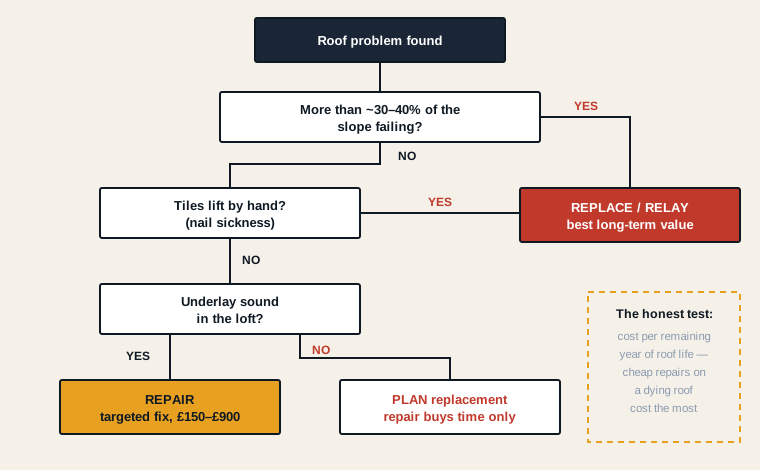
The honest repair-or-replace decision: extent of failure, fixings condition, then underlay.
The decision comes down to three questions, in order: how much of the roof has failed, whether the fixings have gone, and whether the underlay beneath is still sound.
The Framework
The Three Questions
1. How much of the covering has failed?
This is the big one. If failure is contained to one slope, one valley or an isolated patch, repair is almost always the right answer. If more than roughly 30% of the covering has slipped, cracked or is lifting, you have crossed the line where tile-by-tile repair becomes a losing game — you fix one area and the next fails behind it. That is the point where re-roofing becomes the better value.
2. Do the tiles lift by hand?
If tiles lift or slip across the whole slope with no storm to blame, the fixing nails have corroded — nail sickness. This is common on Oxford's 1960s–70s concrete-tile estates like Blackbird Leys, Barton and Risinghurst. Widespread nail sickness means the whole roof will keep shedding tiles no matter how many you refix, so re-covering with stainless fixings is the sensible spend. Isolated slip, though, is just a repair.
3. Is the underlay sound?
Even if the covering looks tired, a roof with sound underlay beneath can often be repaired and kept going. If the underlay (the felt under the tiles) has perished, water gets past any covering repair, and you are into re-roofing territory. This is why our survey always checks the loft, not just the outside.
The honest test: cost per remaining year
The clearest way to decide is cost per remaining year of roof life. Spending £600 on a roof with 15 good years left is excellent value. Spending £600 again and again on a covering that is fundamentally finished is the most expensive path of all — cheap repairs on a dying roof cost the most over time. When the repairs stop buying meaningful years, replacement is cheaper in the long run.
Concrete-tile roofs from the 1960s–70s are the classic re-roof candidates once nail sickness is widespread. Below about 15% tile movement, targeted repair is fine; across the whole deck, re-tiling with stainless fixings ends the cycle for good.
Period Property (Jericho, North Oxford, Headington)
Victorian and Edwardian roofs with sound clay tiles or Welsh slate can usually be repaired almost indefinitely — the tiles outlast the fixings and flashings. Here the honest answer is usually repair: re-lead the chimney, repoint the ridge, refix slipped slates, and keep a hundred-year-old roof going. A full re-roof on sound period covering is often an oversell.
1930s Semis (Summertown, Cowley, Kidlington)
Original clay tiles are often still sound at 90 years; the failures are ridge mortar and lead flashing. These are repairs, not re-roofs, unless the tiles themselves have started failing widely.
Flat roofs & common mistakes
Flat Roofs and the Traps to Avoid
Flat roofs follow their own version of the same logic. A felt flat roof on a 1970s or 1980s Oxford extension has a design life of fifteen to twenty-five years, and the Cherwell and Thames valley humidity in the lower suburbs shortens it further. Once felt starts failing at the seams, patching one split usually just moves the leak to the next weak point within months — because the whole membrane has reached the end of its life together. Here replacement in seamless GRP fibreglass is genuinely the better value, not an oversell, because there is nothing left to repair. The exception is a single, well-defined split on an otherwise sound membrane, which a bonded patch can hold for a season.
The most common mistake we see, in both directions, comes from not checking the deck and the underlay. A cheap contractor who quotes a re-cover without looking underneath may lay new material over a soft, wet deck that fails within a year — a false economy dressed up as a saving. Equally, a roofer who condemns a whole roof without checking whether the underlay is sound may be selling a re-roof the property does not need. The honest answer always comes from looking properly: the covering, the fixings, the underlay and the deck, inside and out. That is exactly what our free survey checks before anyone quotes you a figure.
One last piece of Oxford-specific advice: beware the doorstep caller who tells you your roof needs replacing after “spotting a problem” from the street. No one can assess whether you need a repair or a re-roof without a proper survey of the covering, the loft and the fixings. If someone pressures you toward a full re-roof without that, treat it as the warning sign it is — and get an independent opinion from a firm you approached yourself.
Roof stock condition is best assessed against typical material service lives — concrete tile 40-60 years, clay 60-100+, natural slate 80-120+ — rather than age alone, since a well-maintained older roof can outlast a neglected newer one. — Source: BRE / RICS stock-condition guidance
Get a free, no-obligation quote — a local Oxford roofer will call you back within 2 hours (8am–6pm, Mon–Sat).
"They talked me out of the re-roof another firm had pushed — showed me the underlay was sound and did a repair instead. Honest and saved me a fortune."
Tom B. · Cowley
★★★★★
"Widespread nail sickness on our Barton estate semi, confirmed with a proper survey. Re-tiling was the right call and they explained exactly why. No hard sell, just facts."
Linda K. · Barton
★★★★★
"Wanted an honest second opinion. They said repair would do for now and to plan a re-roof in a few years. That kind of straight advice is rare."
Robert A. · Headington
Common Questions
Frequently Asked Questions
Repair if the failure is contained — a few slipped tiles, one failed flashing, a length of ridge — and the rest of the covering is sound. Replace when failure is widespread across the whole roof, when repeated repairs stop holding, or when the covering has reached the end of its service life. A free survey gives an honest answer.
A common rule of thumb: if more than about 30% of the covering has failed — slipped, cracked or lifting — repairing tile-by-tile costs more over time than re-roofing, because you are constantly chasing the next failure across a covering that is fundamentally at its end. Below that, targeted repair is usually the better value.
Often, yes. A Victorian or Edwardian Oxford roof with sound clay tiles or Welsh slate can be kept going almost indefinitely with lead and mortar maintenance — the tiles outlast several generations of fixings. Age alone is not a reason to replace; condition is what matters.
If tiles lift by hand or slip in ones and twos across the whole slope with no storm to blame, the fixing nails have corroded — nail sickness. It is common on Oxford's 1960s–70s concrete-tile estates. Widespread nail sickness is a re-roof signal; isolated slip is a repair.
When the failure is isolated. If one slope, one valley or a single area has failed but the rest is sound, a targeted repair is far cheaper — and being sold a full re-roof for an isolated problem is a classic oversell. We will tell you honestly when repair is enough.
Concrete tile 40–60 years, clay tile 60–100+, natural slate 80–120+, felt flat roofs 15–25, GRP flat roofs 25+. Where your roof sits in that range, and how it has been maintained, matters more than a single number when deciding repair versus replace.
Yes — it is how we work. Our survey tells you honestly whether repair or replacement is the better value for your specific roof, and if the answer is a modest repair rather than a re-roof, that is what we will recommend. Honesty is why much of our work comes from recommendations.