Specialist heritage roofing across Oxford's conservation areas and listed buildings: matched clay peg tile, Welsh slate, Cotswold stone slate and traditional leadwork. Conservation officer liaison and correct materials throughout.
Quick answer: Heritage roofing in Oxford covers listed buildings and conservation areas using matched traditional materials — clay peg tile, Welsh slate, Cotswold stone slate and lead. Work is priced per specification after survey, with indicative Welsh slate at £180–£280/m². We liaise with conservation officers and handle listed building consent.
✓ NFRC Registered
✓ Fully Insured
✓ 10-Year Guarantee
✓ Free Quotes
✓ No Hidden Costs
Specialist Work
What Heritage Roofing Involves
Heritage roofing is fundamentally different from standard re-roofing. Listed buildings and conservation area properties require materials that match the original in type, colour, profile and surface texture — and often require listed building consent or conservation area prior notification before work begins. The work demands traditional skills: hand-sorting reclaimed clay peg tile, dressing lead to traditional detail, and matching Welsh slate or Cotswold stone by grade and provenance. We carry these skills and understand the consent process.
This page includes our leadwork specialism — flashings, valleys, bay window tops and parapet gutters — which is central to Oxford's heritage roofscape.
Oxford Heritage
Oxford's Conservation Areas and Listed Stock
Named Conservation Areas
Oxford has extensive conservation designation: the North Oxford Victorian Suburb (the Banbury and Woodstock Road avenues), Jericho, Central Oxford, Osney, Old Headington, Iffley village, Old Marston, Wolvercote and Woodstock. Each has a dominant historic material — Welsh slate and clay plain tile in North Oxford, clay plain tile in Jericho, Cotswold stone slate in Woodstock and the western villages. Work on street-facing slopes in these areas requires matched materials and, for material changes, prior notification to Oxford City Council.
Listed Building Density
Oxford has one of the highest concentrations of listed buildings in England outside London, concentrated in the city centre, the college precincts and the older village cores. Roofing work on a listed building requires listed building consent, and materials and methods must satisfy the conservation officer. We handle the consent process and liaise directly with the officer on your behalf.
Dominant Historic Materials
Oxford's heritage roofscape uses clay plain (peg) tile on Victorian and Edwardian properties, Welsh slate on the larger North Oxford villas, and Cotswold stone slate on the western villages and Woodstock. We source matched reclaimed clay peg tile, correct-grade Penrhyn or Ffestiniog Welsh slate, and matched Cotswold stone of the right geological origin. Using the wrong material — or a modern substitute — is both a planning breach and a visual failure.
Heritage Leadwork
Lead is central to Oxford's heritage roofs: Code 4 and Code 5 lead for flashings, valley linings, bay window tops and the concealed parapet gutters of North Oxford's Edwardian villas. We dress lead to traditional detail with correct bay lengths and movement joints, and apply patination oil to prevent staining on surrounding stone, slate or tile. Silicone patching has no place on a heritage roof — only correct lead detailing.
Heritage roofing is priced per specification after a full survey, reflecting the material, the extent of matching required, access and any consent process. The indicative per-square-metre figures give a starting point; the survey produces the accurate quotation. We include conservation officer liaison as part of the service.
The Craft Behind Heritage Roofing
Why Traditional Skills Matter in Oxford
Heritage roofing is a craft, not a product, and the difference shows in the detail. Matching a reclaimed clay peg tile to an existing Oxford roof means sorting through stock by hand for the right size, camber and fired colour, because Victorian tiles varied between makers and even between batches. Re-slating a North Oxford villa in Welsh slate means selecting the correct grade and thickness of Penrhyn or Ffestiniog to sit alongside the originals without a visible seam. Dressing lead to a bay window top or a parapet gutter means forming it to traditional detail with the correct bay lengths and movement joints, so it lasts the sixty to eighty years good leadwork should. None of this can be rushed or substituted, and none of it is within the reach of a general roofer without heritage experience. The consent process is as much part of heritage work as the roofing itself, and getting it wrong carries real consequences. A listed building requires listed building consent for roofing work, and unauthorised work can lead to enforcement requiring reinstatement at your cost — and, in serious cases, prosecution. Conservation area properties need prior notification for material changes on visible slopes. We handle this process for you: preparing the application, specifying the compliant materials, and liaising directly with the conservation officer so the work satisfies the requirements first time. This liaison is included in what we do, not an optional extra, because on a heritage Oxford property it is inseparable from doing the job properly. The reward for doing heritage work correctly is a roof that is both authentic and durable. Oxford's conservation areas and listed buildings look the way they do because generations of correct material choices have preserved their character, and a well-executed heritage re-roof continues that tradition — matched materials, traditional detailing, correct leadwork, all satisfying the conservation requirements while giving the building another lifetime of protection. A heritage roof done properly should be invisible in the best sense: indistinguishable from the original, and good for a hundred years. That is the standard we work to on Oxford's historic buildings.
Roofing work on listed buildings and in conservation areas is governed by the Planning (Listed Buildings and Conservation Areas) Act 1990, with Historic England and SPAB guidance setting the standards for matching materials and traditional methods.— Source: Historic England / SPAB guidance
Listed or conservation area property in Oxford? Book a specialist heritage survey.
"Grade II listed house in Old Headington. They handled the listed building consent, sourced matched clay pegs, and the conservation officer was satisfied throughout. True specialists."
Jonathan P. · Old Headington
★★★★★
"Welsh slate re-roof on our North Oxford villa with all the original lead valleys re-dressed. Matched the Penrhyn slate perfectly. Work of real craftsmanship."
Elizabeth M. · North Oxford
★★★★★
"Cotswold stone slate repair on our Woodstock cottage. Sourced matching stone, no modern substitutes, blended in seamlessly. Exactly the right approach for the conservation area."
Richard H. · Woodstock
Common Questions
Frequently Asked Questions
Listed buildings require listed building consent for roofing work. Conservation area properties need prior notification for material changes on street-facing slopes. Like-for-like repairs in matched materials are generally permitted. We handle the consent process and liaise with the conservation officer.
Clay plain (peg) tile on Victorian and Edwardian properties, Welsh slate on the larger North Oxford villas, and Cotswold stone slate on Woodstock and the western villages, all with traditional leadwork. We source matched materials by grade, colour and provenance.
Heritage roofing is priced per specification after survey. Indicative figures are £180–£280/m² for Welsh slate and £160–£250/m² for clay peg tile, with Cotswold stone and leadwork priced per scope. The survey produces the accurate quotation.
Yes. We liaise directly with the conservation officer at Oxford City Council on your behalf, handle listed building consent and conservation area notifications, and ensure materials and methods satisfy the requirements before work begins.
Listed building and conservation rules require materials matching the original in type, colour, profile and texture. Modern substitutes like fibre cement slate are both a planning breach and a visual failure. We source matched traditional materials to satisfy the requirements.
Yes. Leadwork is central to our heritage service — Code 4 and Code 5 lead for flashings, valleys, bay window tops and parapet gutters, dressed to traditional detail with patination oil. We never use silicone patching on a heritage roof.
All of them, including the North Oxford Victorian Suburb, Jericho, Central Oxford, Osney, Old Headington, Iffley village, Old Marston, Wolvercote and Woodstock. We understand the dominant historic material and requirements of each.
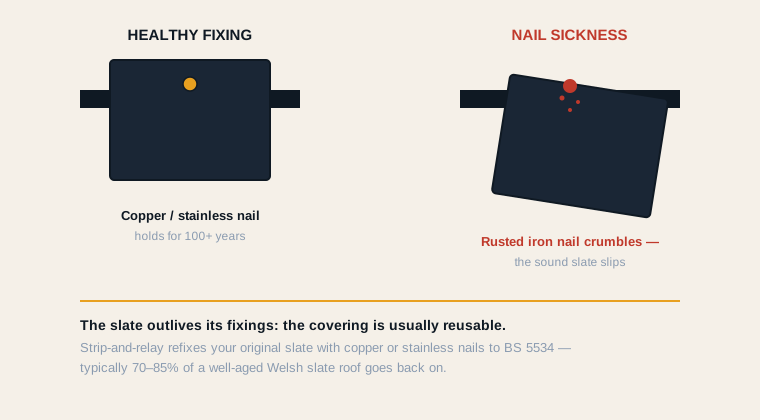
Slate is the dominant historic covering on much of North Oxford and the larger Victorian and Edwardian properties. Slate itself outlasts its fixings, so the failure is usually the nails, not the slate.
Individual slates slipping and appearing in the gutter or on the ground
A scatter of gaps across an otherwise sound slate slope
Damp appearing after driven rain rather than steady rain
Delaminating or flaking slates on an exposed slope
A previous repair using the wrong-size or mismatched slate
When it is not the answer: If only a few slates have slipped from isolated nail failure, targeted refixing is enough — a whole slope should only be stripped when nail sickness is genuinely widespread. Read the full guide.
Nail sickness on slate — strip-and-relay refixes original slate to BS 5534.The process
How a Oxford Slate Roofing Job Runs
1. Survey
We assess the slate condition and, crucially, the nails — testing how widespread any nail sickness is across the slope.
2. Written quote
A fixed-price quote for refixing, matched replacement or strip-and-relay, with slate provenance specified for conservation areas.
3. Source matched slate
Where replacement is needed, we source matched Welsh slate by grade and colour before starting.
4. The work
We refix or relay using copper or stainless nails to BS 5534, reusing sound original slate where possible.
5. Sign-off
We clear the site and hand over the 10-year workmanship guarantee.
Timescales
How Long Does It Take?
Job
Typical duration
Refix slipped slates (per area)
2–4 hours
Matched slate replacement (patch)
Half a day to 1 day
Strip-and-relay (per slope)
3–6 days
Full slate re-roof
1.5–3 weeks
Slate work pauses in high wind — handling slate at height in a gust is unsafe; we build weather margin into the programme.
Access
Scaffold, Skips & Street Access
Slate work needs scaffold for anything beyond a few slipped slates, both for safe access and to stack and sort the slate. Scaffold is specified for: strip-and-relay, re-roofs, and any work beyond refixing a handful of slates - always itemised in your written quote, never a hidden extra, and we arrange it.
Central Oxford's medieval street core and the tight Victorian terraces of Jericho and off the Cowley Road mean rear-access scaffold and permit-controlled pavement space are the norm on many jobs. Pavement scaffold and skip permits go through Oxford City Council; allow a few working days on streets like Holywell Street, Ship Street, St Michael's Street, Merton Street where space is tight.
Pricing
Oxford Slate Roofing: Cost Guide
Job
Typical range
Notes
Refix slipped slates (per area)
£150–£350
Where isolated
Matched slate replacement (patch)
£350–£800
Sourced to match
Strip-and-relay (per slope)
£2,500–£6,000
Reuses sound slate
Full Welsh slate re-roof
£14,000–£28,000+
Natural slate
Copper/stainless refixing
Included
To BS 5534
What moves the price
Extent of nail sickness across the slope
Proportion of original slate reusable
Scaffold for strip-and-relay and re-roofs
Conservation-grade matched slate where required
Worked example: A strip-and-relay of the front slope on a Victorian terrace in Jericho, reusing around 80% of the original Welsh slate with new stainless fixings, typically runs around £3,800.
Staged payment on strip-and-relay and re-roofs against completed work; materials on site first. VAT included in the written quote.
Covering OX1, OX2, OX3, OX4 and surrounding postcodes.
Guarantee
Your Guarantee, Explained
Slate work carries a 10-year workmanship guarantee; reclaimed and new Welsh slate itself has a service life measured in generations.
Covered: workmanship for 10 years, in writing, transferable if you sell.
On top: manufacturer warranties on materials (terms vary by product).
Not covered: storm or impact damage - that is an insurance matter, and we will document it for your claim.
If a fault appears in covered work, we come back and put it right. No quibbling, no re-charge.
Good to know
Disruption, Mess & Weather
Scaffold up for larger jobs, careful sorting of slate on site, and a skip for waste — we protect the grounds and keep the site tidy daily. You do not need to stay home for external work - we just need power and access agreed in advance.
Slate work runs through the year in settled weather; on a strip-and-relay we only open what we can make weathertight each day. The Thames and Cherwell valley setting keeps ambient humidity high, so drying times for mortar, GRP and biocide run longer here than on the surrounding higher ground.
Specialist Heritage Roofing in Oxford
Free survey, written quote, no call-out fee. Covering Oxford and all of Oxfordshire.