Lead roofing specialists in Woodstock — flashings, valleys, soakers, parapet gutters and lead sheet work. Conservation area and period property expertise. Free survey.
Tell us the job in 30 seconds. No pushy sales, no call-out fee.
20+
Years Local
143
5★ Reviews
24/7
Emergency
10yr
Guarantee
✓ NFRC Registered
✓ Fully Insured
✓ 10-Year Guarantee
✓ Free Quotes
✓ No Call-Out Fee
Lead Work in Woodstock
Lead Work Specialists in Woodstock
Lead work failures are the most common cause of roof leaks on Woodstock's Victorian and Edwardian housing stock. Original lead step flashings at chimney stacks, valley linings and soakers on slate properties are now 80–130 years old. Thermal cycling causes the lead to pull away from mortar joints over time. We re-dress, replace and specify all lead work correctly — no silicone, no bodge fixes.
Why Lead Fails
Lead expands and contracts significantly with temperature changes — a typical Oxfordshire winter-to-summer thermal cycle causes measurable movement in lead sheet. Over decades, this cycling pulls lead upstands away from the mortar joints they are dressed into. On Woodstock's older properties, original lead flashings may have been in service for a century without replacement. When the seal fails, water tracks behind the stack or valley before appearing as a ceiling stain — often far from the actual source.
Lead Specification
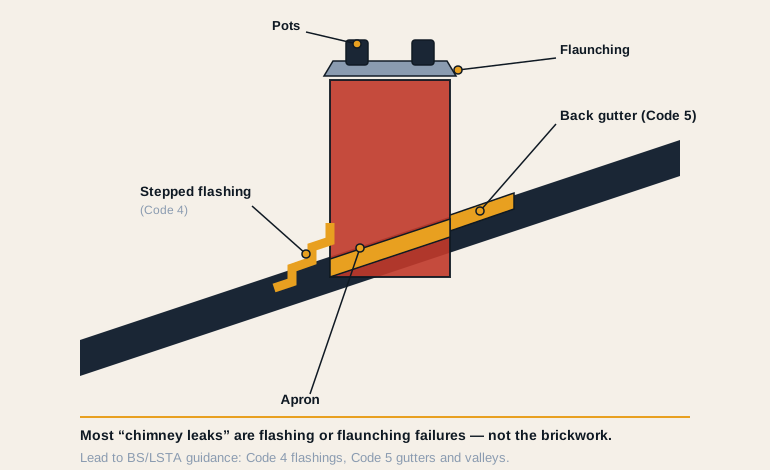
We specify Code 4 lead for flashings and soakers, Code 5 for valley linings and parapet gutters, in line with BS EN 12588 and the Lead Sheet Association technical guidelines. On period and conservation area properties in Woodstock, we use patination oil to prevent white carbonate staining on the surrounding roof material — a detail that matters on clay tile and Welsh slate.
Call 0186 580 3181 to book a free survey in Woodstock. No call-out fee and a written quote before work starts.
Typical Costs in Woodstock
Indicative costs for Woodstock properties. All jobs are surveyed and quoted in writing.
Lead flashing repair (one junction)£250–£500
Full chimney re-lead (step + back + soakers)£600–£1,400
Valley relining (Code 5, per 3m run)£400–£800
Parapet gutter relining (per m run)£350–£700
Lead soaker replacement (per ridge)£300–£600
Lead flat roof (per m2)£200–£350/m2
Free survey & written quote
No call-out fee. We survey and quote before any work starts.
Leadwork in Woodstock centres on the period stock — the chimney flashings, valleys and bay-window tops around the conservation core by Blenheim where original Victorian and Edwardian lead is now past its life. We dress new Code 4–5 lead to traditional detail with correct bay lengths so it lasts, rather than smearing silicone over a failing joint.
Code 4 and Code 5 lead to BS EN 12588 throughout. No under-specification.
02
No Silicone
Silicone is not a durable lead repair. We re-dress or replace — permanently.
03
Period Property
Conservation area and listed building lead work carried out regularly across Oxford.
04
10-Year Guarantee
All lead work covered by our written 10-year workmanship guarantee.
Leadwork in Woodstock is conservation work by default — the honey-coloured Cotswold stone town beside Blenheim sits almost entirely within its conservation area, and its lead at flashings, valleys and parapets must be renewed sympathetically, traditionally, and often under listed-building consent. The original lead has fatigued and failed as elsewhere, but every detail here has to respect the protected stone fabric. Woodstock's higher, exposed Cotswold-edge position by the Glyme drives weather into any failed lead joint. We dress new Code 4–5 lead to the flashings with welted joints and re-line the valleys and parapet gutters in Code 5 with proper falls, matching the historic detail and coordinating with conservation requirements. New lead is oiled to prevent carbonate staining, which would be especially conspicuous against Woodstock's pale honey-coloured stone.
Honest advice
How to Tell You Need Lead Work
In Woodstock, the roofs we are called to reflect the town's own building character. Woodstock is a small, almost entirely conservation-area Cotswold town beside Blenheim, built in honey-coloured stone with clay tile and Cotswold stone-slate roofs on Georgian and older frontages — a stock where heritage matching is the rule, not the exception. Woodstock stands on higher Cotswold-edge ground by the Glyme, well-drained but exposed, where the traditional stone-slate roofs demand specialist fixing and the prevailing weather tests the old verges.
Leadwork in Woodstock centres on the period stock — the chimney flashings, valleys and bay-window tops around the conservation core by Blenheim where original Victorian and Edwardian lead is now past its life. We dress new Code 4–5 lead to traditional detail with correct bay lengths so it lasts, rather than smearing silicone over a failing joint. A sound Woodstock lead flashing with a single lifted edge can sometimes be re-dressed rather than fully replaced — and silicone smeared over lead is never the right fix, so be wary of anyone offering it as a cheap shortcut.
Lead failure is behind a large share of Oxford's period-property leaks. Original Victorian and Edwardian lead at chimneys, valleys and bay tops is now past its service life and pulling away from the masonry.
White staining or lead debris on the roof or wall below
A previous silicone 'repair' over lead that has failed again
Water entering where two roof slopes or a slope and wall meet
When it is not the answer: A sound lead flashing with a single lifted edge can sometimes be re-dressed rather than replaced — and silicone over lead is never the right fix, so beware anyone offering it. Read the full guide.
Lead detailing at a chimney — correctly dressed lead lasts decades.The process
How a Oxford Lead Work Job Runs
1. Survey
Every Woodstock job follows the same disciplined sequence, adapted to the property — a period roof around the conservation core by Blenheim gets more survey and matching time than a modern estate roof, but the steps are the same.
We assess the lead at chimneys, valleys, bays and abutments, and identify what has failed and why.
2. Written quote
A fixed-price quote specifying the lead code and detail, with conservation matching noted where required.
3. Scheduling
Booked to suit access; leadwork on a period property is planned around dry weather for a proper finish.
4. Dress the lead
We form and dress the lead to traditional detail with correct bay lengths and movement joints, and patination oil to prevent staining.
5. Sign-off
We clear the site and hand over the 10-year workmanship guarantee.
Timescales
How Long Does It Take?
Job
Typical duration
Single flashing junction
Half a day
Full chimney re-lead
1–2 days
Valley re-line (per valley)
1–2 days
Bay window top re-lead
1 day
Leadwork needs dry conditions to dress and seal properly; we schedule around Oxford's wetter spells rather than rush a compromised finish.
Access
Scaffold, Skips & Street Access
Almost all of Woodstock's core sits within the conservation area beside Blenheim, so matched Cotswold materials, careful permit scaffold on narrow streets and heritage-appropriate methods apply on the majority of roofs here.
Leadwork at chimneys and valleys needs safe standing time, so scaffold is usual; low bay-window leadwork can sometimes be reached from a tower. Scaffold is specified for: chimney, valley and abutment leadwork where safe standing access at height is essential - always itemised in your written quote, never a hidden extra, and we arrange it.
Central Oxford's medieval street core and the tight Victorian terraces of Jericho and off the Cowley Road mean rear-access scaffold and permit-controlled pavement space are the norm on many jobs. Pavement scaffold and skip permits go through Oxford City Council; allow a few working days on streets like Holywell Street, Ship Street, St Michael's Street, Merton Street where space is tight.
Access in Woodstock is dominated by the conservation setting: almost the whole core sits within the conservation area beside Blenheim, so careful permit scaffold on narrow streets and heritage-appropriate setup apply on the majority of roofs. We coordinate with the conservation requirements, arrange any permit, and itemise the scaffold, so a Woodstock quote reflects the genuine logistics of working on a protected building in a protected street rather than a standard assumption.
Pricing
Oxford Lead Work: Cost Guide
Job
Typical range
Notes
Single flashing junction
£280–£550
Code 4–5 lead
Full chimney re-lead
£450–£900
All abutments
Valley re-line (per valley)
£550–£1,200
Traditional detail
Bay window top re-lead
£450–£850
Period bay
Lead ridge / hip (per m)
£70–£130
Where specified
What moves the price
Lead code and quantity required
Scaffold for chimney and valley access
Conservation matching of detail on period property
Complexity of the abutment or junction
Worked example: Re-leading the valley on an Edwardian property in North Oxford, including scaffold and traditional bay-length detailing, typically runs around £950.
Staged payment on scaffold-based leadwork; materials on site first. VAT included in the written quote.
Covering OX1, OX2, OX3, OX4 and surrounding postcodes.
Guarantee
Your Guarantee, Explained
The same written guarantee applies to every roof we complete in Woodstock and the surrounding villages.
Leadwork carries a 10-year written workmanship guarantee; correctly dressed Code 4–5 lead should itself last decades.
Covered: workmanship for 10 years, in writing, transferable if you sell.
On top: manufacturer warranties on materials (terms vary by product).
Not covered: storm or impact damage - that is an insurance matter, and we will document it for your claim.
If a fault appears in covered work, we come back and put it right. No quibbling, no re-charge.
Good to know
Disruption, Mess & Weather
Scaffold to the work area and some quiet, skilled hand-work — minimal mess, and we clear and check the finish before leaving. You do not need to stay home for external work - we just need power and access agreed in advance.
Leadwork runs year-round in dry spells; Oxford's valley humidity means we pick settled windows for the best patination and seal. The Thames and Cherwell valley setting keeps ambient humidity high, so drying times for mortar, GRP and biocide run longer here than on the surrounding higher ground.
Customer Reviews
Lead Work Reviews from Woodstock
★★★★★
"Lead flashing at our chimney had been patched with silicone by a previous roofer. They stripped it, re-led it properly to Code 4 specification and dressed it into raked mortar joints. Dry ever since."
Diana W. · Woodstock
★★★★★
"Full valley relining on our Edwardian property. Code 5 lead, correct joints, patination oil applied. Excellent technical standard — exactly what the conservation area requires."
Kevin S. · Woodstock area
★★★★★
"Parapet gutter relining on a North Oxford villa. The previous lining had failed silently for years. Completely stripped and re-lined. No more ceiling staining."
Lesley T. · Woodstock
Call 0186 580 3181 for a free survey — no call-out fee.
FAQ
Lead Work Woodstock — Common Questions
Lead flashing repair at a single chimney junction in Woodstock costs £250–£500. Full chimney re-leads covering step flashings, back gutter and soakers cost £600–£1,400. Valley relining costs £400–£800 per 3m run. Free written quotes provided.
Lead expands and contracts with temperature changes — Oxfordshire's four-season climate means significant thermal movement annually. Over decades, this cycling pulls lead upstands away from mortar joints. On Woodstock's older Victorian and Edwardian properties, original lead flashings may have been in service for 80–130 years.
No. Silicone bonds to the lead-to-brick interface but splits within one or two seasons as the lead continues to move thermally. It is a temporary measure that typically delays the problem by 1–3 years. The correct repair is re-dressing the lead upstand into a raked mortar joint — we carry out permanent repairs only.
We specify Code 4 lead (1.8mm) for flashings and soakers, and Code 5 lead (2.24mm) for valley linings and parapet gutters, in line with BS EN 12588 and Lead Sheet Association guidelines. We never under-specify lead gauge on cost grounds.
Yes. We work on conservation area and listed building properties across Woodstock and Oxfordshire regularly. We understand the specification requirements and use patination oil on period properties to prevent staining.
A parapet gutter is a concealed lead-lined gutter built behind a low stone or brick parapet wall — common on Victorian and Edwardian villas in Woodstock. They block silently and fail without visible external signs. Water penetration through a failing parapet gutter typically appears as persistent damp on an interior wall or ceiling below the parapet level.
Correctly specified and installed lead work lasts 50–80 years or more. The original lead flashings on many Victorian and Edwardian Woodstock properties are still in service after 100 years. When we re-lead, we use correctly specified gauge and correct fixing technique to achieve full design life.
Lead flashings on Woodstock's period housing stock are failing after 80–130 years of thermal cycling. Cotswold stone slate delamination; conservation area requiring matched materials on all street-facing slopes. The failure is consistent: lead upstands pull away from raked mortar joints, water tracks behind the stack or valley, and ceiling staining appears inside the property — often offset from the actual failure point because water follows the roof timbers before dripping through.
Woodstock Climate and Lead Performance
Woodstock's elevated Glyme Valley with Blenheim Park tree canopy generating heavy autumn gutter loading creates specific conditions for lead performance. We specify Code 4 lead for flashings and soakers, Code 5 for valley linings and parapet gutters, in line with BS EN 12588 and Lead Sheet Association guidelines. On period and conservation area Woodstock properties we apply patination oil to prevent carbonate staining on surrounding tiles.
Why Silicone Fails on Woodstock Lead Work
Silicone applied to failing lead flashings on Woodstock properties bonds initially but splits within one to two seasons as thermal movement continues. We carry out permanent lead repairs only — re-dressing the upstand into a freshly raked mortar joint, or replacing the lead section where it has split or degraded. Written fixed-price quote before any work starts.
Free survey in Woodstock. Written quote before work starts, no call-out fee. Call 0186 580 3181.
Get In Touch
Free Lead Work Quote in Woodstock
No call-out fee. Written quote before work starts. Local roofers who know Woodstock.