Local roofing specialists serving Didcot, Abingdon, Wantage, Wallingford and the surrounding area. Fast diagnosis, honest pricing, no call-out fee. Repairs from £150.
Tell us the job in 30 seconds. No pushy sales, no call-out fee.
20+
Years Local
127
5★ Reviews
24/7
Emergency
10yr
Guarantee
✓ NFRC Registered
✓ Fully Insured
✓ 10-Year Guarantee
✓ Free Quotes
✓ No Hidden Costs
✓ No Call-Out Fee
Roof Repairs in Didcot
Roof Repair Specialists in Didcot
Most roof problems in Didcot are caused by the same handful of issues — widespread nail sickness on northbourne and ladygrove 1950s–1970s estates — oxford road corridor is particularly affected, flat roof failure on the large proportion of 1970s–1980s garage and extension stock and ridge bedding failure on the post-war stock throughout didcot. We diagnose and fix all of them, with no call-out fee and a written quote before work starts.
Didcot Housing Stock
Didcot is largely a product of post-war planned expansion to accommodate Harwell and Culham scientific establishment workers. The Northbourne and Ladygrove estates are characterised by 1950s–1970s semi-detached concrete tile construction. The older town near the station has some Victorian terracing.
The dominant roof type in Didcot is concrete interlocking tiles throughout the majority of the town. This material profile shapes the repair and replacement work we carry out across the area.
Common Problems in Didcot
Widespread nail sickness on Northbourne and Ladygrove 1950s–1970s estates — Oxford Road corridor is particularly affected
Flat roof failure on the large proportion of 1970s–1980s garage and extension stock
Ridge bedding failure on the post-war stock throughout Didcot
Didcot's flat Vale of White Horse location gives it one of the highest wind exposure ratings in Oxfordshire. The absence of topographic shelter means south-westerly and north-easterly winds hit roof slopes unimpeded, accelerating mortar erosion and tile displacement.
Typical Roof Repairs Costs in Didcot
These are real indicative costs for Didcot properties. All jobs are surveyed and quoted in writing — these ranges give you a realistic starting point.
Replace 1–5 tiles (concrete)£150–£280
Replace 1–5 clay plain tiles£200–£400
Ridge repointing (full run)£300–£600
Lead flashing repair£250–£500
Valley relining (Code 4 lead)£400–£900
Full chimney re-lead£600–£1,200
Free survey & written quote
No call-out fee. We survey, diagnose and quote in writing before any work starts.
On Didcot roofs, the repairs that come up most are tied to that stock — slipped tiles and perished mortar on the older frontages around the terraces near the station and Ladygrove, and wind-lifted or cracked interlocking tile on the estate roofs. We match the fix to what the roof in front of us actually is, rather than reaching for a standard job sheet.
We survey the problem free and quote in writing before lifting a tile.
02
Same-Day Response
Most repair enquiries receive a survey visit within 24–48 hours.
03
10-Year Guarantee
All repair work is backed by our written 10-year workmanship guarantee.
04
Local Knowledge
We know the housing stock and the common failure points inside out.
Honest advice
How to Tell You Need Roof Repairs
In Didcot, the roofs we are called to reflect the town's own building character. Didcot grew fast around the railway and power station, so its stock is overwhelmingly Victorian railway terraces near the station giving way to large modern estates at Ladygrove and Great Western Park — slate on the oldest terraces, concrete interlocking across the new build. Didcot sits on the open Vale gravels below the Downs, a comparatively dry, exposed setting where wind-driven rain on the newer estates and slate slippage on the older terraces are the common faults.
On Didcot roofs, the repairs that come up most are tied to that stock — slipped tiles and perished mortar on the older frontages around the terraces near the station and Ladygrove, and wind-lifted or cracked interlocking tile on the estate roofs. We match the fix to what the roof in front of us actually is, rather than reaching for a standard job sheet. The valley and hill geography around Didcot matters here too: where a roof sits determines how fast a small fault turns into an internal leak, so what looks minor on an exposed Didcot slope is worth checking sooner rather than later.
Most Oxford roof problems announce themselves indoors before they are visible outside — a damp patch, a dripping loft, or debris in the gutter. The question is whether it is a contained repair or the first sign of a covering at the end of its life.
A damp patch on an upstairs ceiling that darkens after rain
Daylight or wet timber visible in the loft
Slipped, cracked or missing tiles seen from the ground
Debris from the roof (mortar, tile fragments) in the gutters or on the drive
Staining down a chimney breast or near a valley
When it is not the answer: If more than about a third of the covering has slipped or the whole roof lifts tile-by-tile from nail sickness, repairing piece-by-piece is money wasted — re-roofing is the better long-term value. Read the full guide.
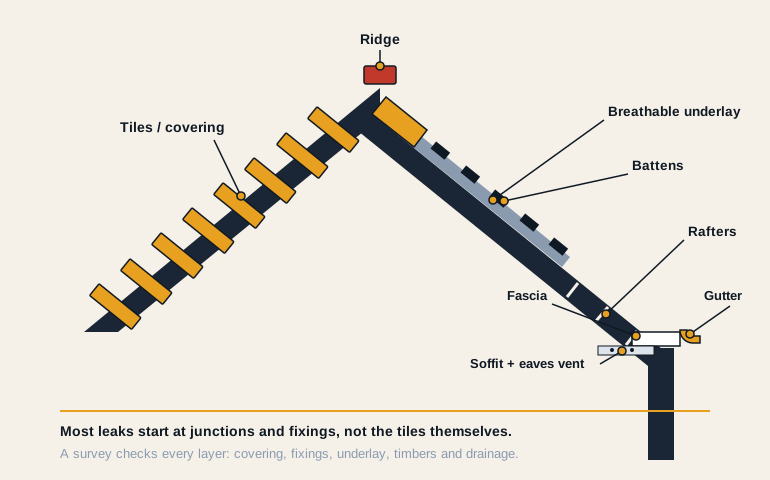
The layers of a pitched roof — most leaks start at junctions and fixings, not the tiles.The process
How a Oxford Roof Repairs Job Runs
1. Survey & diagnosis
Every Didcot job follows the same disciplined sequence, adapted to the property — a period roof around the terraces near the station and Ladygrove gets more survey and matching time than a modern estate roof, but the steps are the same.
We inspect the roof and the loft to find the true source — water often tracks metres from the entry point on Oxford's older long-rafter roofs. No call-out fee.
2. Written itemised quote
You get a fixed-price written quote naming the materials and the exact scope, with scaffold or access itemised, not a vague verbal figure.
3. Scheduling
Scheduled repairs are usually booked within 5–10 working days; active leaks are prioritised for same-day make-safe.
4. The repair
We carry out the repair with matched materials where conservation compliance requires it, and protect the area below.
5. Cleanup & sign-off
We clear all debris, water-test where relevant, and hand over the written 10-year workmanship guarantee.
Wet or high-wind days pause tiling and leadwork — we build weather margin into every Oxford booking and make the roof safe at the end of each day.
Access
Scaffold, Skips & Street Access
The Victorian terraces near Didcot station have narrow frontages where pavement scaffold needs a South Oxfordshire permit; the Ladygrove and Great Western Park estates are open modern layouts with driveway access for towers.
Most Oxford repairs run from towers or roof ladders; scaffold is quoted only where the job needs safe standing time at height. Scaffold is specified for: chimney-side repairs, full valley rebuilds, and anything beyond a day working at height - always itemised in your written quote, never a hidden extra, and we arrange it.
Central Oxford's medieval street core and the tight Victorian terraces of Jericho and off the Cowley Road mean rear-access scaffold and permit-controlled pavement space are the norm on many jobs. Pavement scaffold and skip permits go through Oxford City Council; allow a few working days on streets like Holywell Street, Ship Street, St Michael's Street, Merton Street where space is tight.
Conservation-area material matching (clay, slate, lime mortar)
Extent hidden until the area is opened up
Worked example: A rear valley rebuild on a 1930s semi in Summertown, including tower access and waste removal, typically runs around £680.
No deposit on repairs under £500. Staged payments on larger jobs — nothing up front before materials are on site. VAT included in every written quote.
Covering OX1, OX2, OX3, OX4 and surrounding postcodes.
Guarantee
Your Guarantee, Explained
The same written guarantee applies to every roof we complete in Didcot and the surrounding villages.
Workmanship on the repaired section is covered for 10 years in writing; any replacement tiles, slates or lead carry their manufacturer warranties on top.
Covered: workmanship for 10 years, in writing, transferable if you sell.
On top: manufacturer warranties on materials (terms vary by product).
Not covered: storm or impact damage - that is an insurance matter, and we will document it for your claim.
If a fault appears in covered work, we come back and put it right. No quibbling, no re-charge.
Good to know
Disruption, Mess & Weather
A day of ladder or tower work and a small amount of tile debris — we sheet below the work area and clear everything before we leave. You do not need to stay home for external work - we just need power and access agreed in advance.
Repairs run year-round; temporary weatherproofing goes on the same day if rain stops work mid-job. The Thames and Cherwell valley setting keeps ambient humidity high, so drying times for mortar, GRP and biocide run longer here than on the surrounding higher ground.
Customer Reviews
Roof Repairs Reviews from Didcot
★★★★★
"Had a slipped tile causing a drip into the back bedroom. Called in the morning, surveyed by lunchtime, repaired the same afternoon. Excellent, efficient service."
Helen R. London Road, Headington
★★★★★
"We had ongoing issues with a lead flashing around the chimney that two previous roofers had patched rather than fixed. Oxford Roofing Experts stripped it back and re-led it properly. No issues since."
Mark S. Lime Walk, Headington
★★★★★
"Straightforward ridge repointing job done quickly and cleanly. Fair price, no upselling, left everything tidy."
Most roof repairs in Didcot cost between £150 and £600. Minor issues such as tile replacement, ridge repointing and flashing repairs fall in the lower end. Valley relining and chimney lead work typically costs £400–£1,200. We provide free, written quotes so you know the exact cost before work begins.
For standard repairs we typically survey within 24–48 hours and carry out the work within a few days. Emergency repairs can be arranged same-day. Call 0186 580 3181 to discuss your timeline.
The most common repair calls we receive from Didcot are: widespread nail sickness on northbourne and ladygrove 1950s–1970s estates — oxford road corridor is particularly affected, flat roof failure on the large proportion of 1970s–1980s garage and extension stock, and ridge bedding failure on the post-war stock throughout didcot.
Yes. All repair work carried out in Didcot is covered by our written 10-year workmanship guarantee. If the repair fails within that period, we return and fix it at no cost.
No. We don't charge a call-out fee for surveys or quotes in Didcot. You'll receive a written quote before any work starts and there's no obligation to proceed.
Most repairs in Didcot are completed in a single visit of 2–4 hours. Larger jobs such as full chimney re-leads or valley relining take a full day. We survey and confirm the timeline in writing before starting.
Didcot's dominant roof type is post-war and 1960s–1970s planned expansion estates. We work on this stock regularly and understand the specific failure modes — including widespread nail sickness on Northbourne and Ladygrove estates.
Why Didcot Specifically
Roof Repairs in Didcot — Local Factors
Climate and Exposure
Didcot's flat Vale of White Horse location gives it one of the highest wind exposure ratings in Oxfordshire. The absence of topographic shelter means south-westerly and north-easterly winds hit roof slopes without the buffering effect of hills or valleys available to most Oxfordshire towns. This sustained wind exposure accelerates mortar erosion on ridge beds and hip points, and increases the rate of tile displacement on any nail-sick roof. Didcot properties lose ridge mortar noticeably faster than equivalent Abingdon or Oxford properties.
Housing Stock and Failure Patterns
Didcot is predominantly a post-war planned town, developed to house workers at the Harwell and Culham scientific establishments. The Northbourne and Ladygrove estates are characterised by 1950s–1970s semi-detached concrete tile construction — the largest concentration of nail-sickness-age roofing in south Oxfordshire. The Broadway and Station Road area has some Victorian terracing, but the dominant roofscape is overwhelmingly post-war. The Science Bridge and surrounding newer development brings the most recent construction into the mix.
Didcot generates more nail sickness re-roof calls per square mile than any other town in the district. The Northbourne estate alone — 1950s construction — now has properties approaching 70 years of age without re-roofing, which is at the upper limit of ferrous-nailed concrete tile performance under any conditions, and well beyond it given Didcot's wind exposure. A survey on a Northbourne property almost always confirms wholesale nail failure.
What to Expect
How We Handle Roof Repairs
✓
Free Survey
We attend the property, access the roof where safe, and systematically inspect the affected area and surrounding tiles. We check nail fixings, pointing, flashings and the immediate tile condition. If loft access is available, we inspect the underside of the deck for water staining that indicates the true extent of any ingress.
✓
Written Quote
You receive a fixed-price written quote before any work begins. For repairs, this includes materials, labour and any scaffold or access equipment required. There are no call-out fees and no surprises on the invoice.
✓
The Repair
We match materials to your existing tile where possible — for clay plain tiles on period properties this means sourcing reclaimed stock of the correct size and firing. We carry out the repair, clear all debris, and carry out a final visual check from ground level.
✓
Guarantee
All repair work is covered by our 10-year written workmanship guarantee. If the repair fails within that period, we return and fix it at no charge.
Free survey in Didcot:
Call 0186 580 3181
to book. No call-out fee. Written quote before work starts. Didcot is 15 miles south of Oxford.
Get In Touch
Free Roof Repairs Quote in Didcot
No call-out fee. Written quote before work starts. Local roofers who know Didcot.