Roof tiling specialists in Abingdon — clay plain tiles, concrete interlocking and period tile matching. Repairs, re-tiling and full re-roofs. Free survey, no call-out fee.
Tell us the job in 30 seconds. No pushy sales, no call-out fee.
20+
Years Local
143
5★ Reviews
24/7
Emergency
10yr
Guarantee
✓ NFRC Registered
✓ Fully Insured
✓ 10-Year Guarantee
✓ Free Quotes
✓ No Call-Out Fee
Roof Tiling in Abingdon
Roof Tiling Specialists in Abingdon
The dominant roof tile in Abingdon is clay plain tiles in town centre; concrete interlocking on estates. Each tile type has its own failure modes, its own material sourcing requirements, and its own installation specification. We work with all tile types found across Abingdon's Victorian town centre and 1960s–1980s estates housing stock and carry out repairs, re-tiling and full re-roofs with matched materials and a written guarantee.
Tile Matching for Period Properties
Period properties in Abingdon requiring clay plain tile or Welsh slate repair present a matching challenge — standard builders' merchant stock will not match the colour, size or surface texture of original tiles. We maintain supplier relationships for sourcing reclaimed clay tiles and matched slate, and carry out colour assessment on every survey where matching is required.
Nail Sickness and Re-Tiling
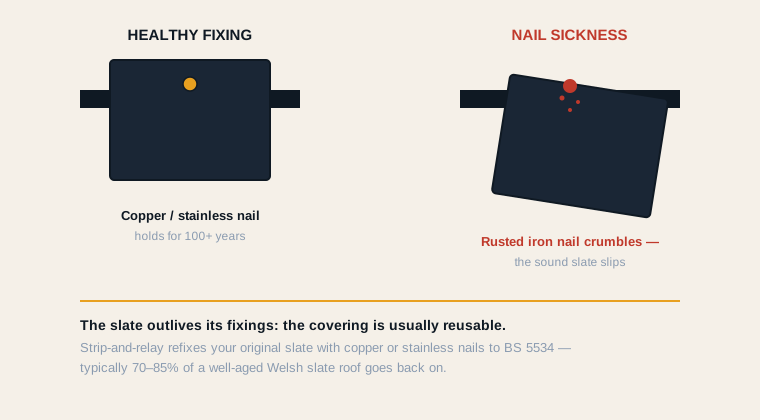
Post-war and 1960s–1970s concrete tile properties across Abingdon are now at peak nail sickness risk. Ferrous nails corroding after 50–70 years cause tiles to slip progressively across the whole deck. Re-tiling with stainless steel or aluminium fixings is the permanent solution. We carry out full nail sickness surveys across Abingdon at no charge.
Call 0186 580 3181 to book a free survey in Abingdon. No call-out fee and a written quote before work starts.
Typical Costs in Abingdon
Indicative costs for Abingdon properties. All jobs are surveyed and quoted in writing.
Replace 1–5 tiles (concrete)£150–£280
Replace 1–5 clay plain tiles (matched)£200–£450
Ridge re-bed and repoint (full run)£350–£650
Re-tile one slope (3-bed semi)£1,800–£3,200
Full re-tile (3-bed semi, concrete)£5,500–£8,500
Full re-tile (3-bed semi, clay tile)£7,500–£13,000
Free survey & written quote
No call-out fee. We survey and quote before any work starts.
When a Abingdon roof reaches replacement, the covering choice is driven by the property: matched clay or natural slate on the period frontages around the Market Place and East St Helen Street, concrete interlocking on the estate stock. On protected Abingdon roofs we spec to what conservation requires, not to whatever is cheapest to buy.
Reclaimed clay and matched slate sourced for period properties. No visible repairs.
02
Nail Sickness
Free nail sickness surveys. Stainless steel fixings throughout — no recurrence.
03
Free Survey
Written quote before work starts. No call-out fee across the Oxford area.
04
10-Year Guarantee
All tiling work covered by our written 10-year workmanship guarantee.
Honest advice
How to Tell You Need Roof Replacement
In Abingdon, the roofs we are called to reflect the town's own building character. Abingdon mixes Georgian and Victorian stock around the Market Place and East St Helen Street with large post-war and 1970s estates out towards Caldecott and Peachcroft. Clay peg tile and natural slate dominate the older core; concrete interlocking covers the estates. Abingdon sits low on the Thames floodplain at the Ock confluence, so riverside properties see higher humidity and faster moss growth on north-facing slopes than the town's higher southern edge.
When a Abingdon roof reaches replacement, the covering choice is driven by the property: matched clay or natural slate on the period frontages around the Market Place and East St Helen Street, concrete interlocking on the estate stock. On protected Abingdon roofs we spec to what conservation requires, not to whatever is cheapest to buy. We will always tell a Abingdon homeowner honestly when a repair will still hold; a full re-roof is the right call only when the covering has genuinely reached the end of its life across the whole roof, not just on one tired slope.
A full re-roof is a major spend, and an honest roofer will tell you when you do not yet need one. It becomes the right call when repairs stop holding or the covering has reached the end of its service life across the whole roof.
Tiles lifting by hand across the roof (widespread nail sickness)
Repeated leaks appearing in different places after each repair
Sagging or dipping in the roof line seen from the street
Widespread slipped or delaminating slates on a Victorian or Edwardian property
A covering visibly past its age — brittle concrete tile, crumbling mortar throughout
When it is not the answer: If the failure is contained to one slope or a single area, a targeted repair is far cheaper — do not let anyone sell you a full re-roof for an isolated problem. Read the full guide.
Nail sickness: the slate outlives its fixings, so the covering is often reusable.The process
How a Oxford Roof Replacement Job Runs
1. Survey & measure
Every Abingdon job follows the same disciplined sequence, adapted to the property — a period roof around the Market Place and East St Helen Street gets more survey and matching time than a modern estate roof, but the steps are the same.
We measure the roof, assess the timbers and confirm material requirements — including any conservation matching for your Oxford property.
2. Written itemised quote
A fixed-price quote covering scaffold, strip, disposal, membrane, battens, covering and the guarantee, with VAT status confirmed in writing.
3. Scheduling & materials
We schedule the re-roof, typically within 2–4 weeks, allowing lead time for matched clay or slate where a conservation area requires it.
4. Scaffold & strip
Scaffold goes up, the old covering is stripped to the timbers, and the deck is inspected before anything new is laid.
5. Re-cover & sign-off
New membrane, battens and covering are laid with stainless fixings; we clear all waste and issue the 10-year guarantee.
Sustained rain or high wind pauses a strip-off; we only open up what we can make weathertight by the end of the working day.
Access
Scaffold, Skips & Street Access
In Abingdon's medieval core around East St Helen Street and the Market Place, access is tight and pavement scaffold needs a permit from the Vale of White Horse; the Caldecott and Peachcroft estates are far more open with driveway room for towers.
A full re-roof always needs scaffold for safe access and to move materials — it is included as a line item in the quote. Scaffold is specified for: the whole job — a re-roof is never done without full scaffold - always itemised in your written quote, never a hidden extra, and we arrange it.
Central Oxford's medieval street core and the tight Victorian terraces of Jericho and off the Cowley Road mean rear-access scaffold and permit-controlled pavement space are the norm on many jobs. Pavement scaffold and skip permits go through Oxford City Council; allow a few working days on streets like Holywell Street, Ship Street, St Michael's Street, Merton Street where space is tight.
Pricing
Oxford Roof Replacement: Cost Guide
Job
Typical range
Notes
2-bed terrace re-roof
£5,500–£8,500
Concrete or clay, incl. scaffold
3-bed semi re-roof
£8,000–£13,000
Covering-dependent
Detached / larger property
£12,000–£20,000+
Size & material driven
Welsh slate re-roof (period)
£14,000–£28,000+
Matched natural slate
Timber / structural repairs
£300–£1,500
If found on strip
What moves the price
Roof size, pitch and number of slopes
Covering: concrete tile, clay, or natural slate
Scaffold scale and duration
Conservation constraints on materials in Oxford's protected areas
Condition of timbers found once stripped
Worked example: A full concrete-tile re-roof on a 3-bed semi in Cowley, including scaffold, strip, new membrane, battens and covering, typically lands around £10,500.
Staged payments on re-roofs against completed work — never a large sum before materials are on site. Written fixed-price quote with VAT stated.
Covering OX1, OX2, OX3, OX4 and surrounding postcodes.
Guarantee
Your Guarantee, Explained
The same written guarantee applies to every roof we complete in Abingdon and the surrounding villages.
The full re-roof carries a 10-year written workmanship guarantee; the covering and membrane carry their own manufacturer warranties, often 15–30 years, on top.
Covered: workmanship for 10 years, in writing, transferable if you sell.
On top: manufacturer warranties on materials (terms vary by product).
Not covered: storm or impact damage - that is an insurance matter, and we will document it for your claim.
If a fault appears in covered work, we come back and put it right. No quibbling, no re-charge.
Good to know
Disruption, Mess & Weather
A re-roof means scaffold up for the duration, some noise during strip and nailing, and a skip on site — we protect the garden and drive and keep the site tidy daily. You do not need to stay home for external work - we just need power and access agreed in advance.
Re-roofs run through most of the year; we schedule strip-offs around settled-weather windows and never leave a roof open overnight. The Thames and Cherwell valley setting keeps ambient humidity high, so drying times for mortar, GRP and biocide run longer here than on the surrounding higher ground.
Customer Reviews
Roof Tiling Reviews from Abingdon
★★★★★
"Re-tiling after nail sickness across the whole rear slope. They sourced reclaimed clay tiles that matched perfectly — you cannot tell which tiles are original. Excellent work."
Margaret H. · Old Abingdon
★★★★★
"Full re-roof on our 1960s semi. Surveyed the timber first, found two rotten battens and replaced them before re-tiling. No surprises on the invoice — everything was in the quote."
Lawrence M. · Abingdon
★★★★★
"Replaced a section of slipped concrete tiles with matching stock. Quick and tidy. Exactly what you want."
Frances T. · Abingdon area
Call 0186 580 3181 for a free survey — no call-out fee.
FAQ
Roof Tiling Abingdon — Common Questions
Replacing a handful of tiles in Abingdon costs £150–£450 depending on tile type. Re-tiling a single slope costs £1,800–£3,200. A full re-roof on a 3-bed semi costs £5,500–£13,000 depending on materials. Free written survey and quote.
Yes. We source reclaimed clay plain tiles and matched slate for repair work on period Abingdon properties. We assess colour, size and surface texture on the survey to identify the closest match available.
Nail sickness is the corrosion of the ferrous nails used to fix tiles to battens. Post-war and 1960s–1970s properties in Abingdon — typically concrete interlocking tile — are now at peak nail sickness age. Tiles slip progressively as the nails fail. A free survey will confirm whether your property is affected.
Yes. Conservation area properties and listed buildings in Abingdon typically require like-for-like material replacement — clay plain tiles cannot be replaced with concrete, and reclaimed or matched materials are usually specified. We check requirements on every Abingdon survey.
Re-tiling a single slope takes 1–2 days. A full re-roof on a 3-bed semi in Abingdon takes 3–5 days. Larger or more complex properties take 5–10 days. Scaffold is included in the written quote.
Yes. All tiling work in Abingdon is covered by our 10-year written workmanship guarantee. Materials also carry manufacturer guarantees — typically 30–40 years on concrete tile.
The two main causes are nail sickness (corroding fixings on post-war concrete tile properties) and tile damage from impact or freeze-thaw cycling. On period clay tile properties, original lime mortar ridge beds also fail over time. All causes are identified on the free survey.
Abingdon's Victorian town centre and 1960s–1980s expansion estates housing stock has accelerated organic growth on riverside properties; nail sickness on post-war Peachcroft and Northcourt estates. We assess the specific tile type on every survey — clay plain tiles on older period properties require matched reclaimed sourcing for conservation area compliance, while concrete interlocking tile on post-war stock is assessed for nail sickness with stainless fixings used throughout any re-tiling work.
Abingdon Climate and Tile Performance
Abingdon's Thames floodplain humidity, highest moss growth rates in the district on riverside properties creates specific tile performance conditions. Wind loading on exposed Abingdon properties accelerates tile displacement once nail fixings begin to corrode, and the frost cycling of Oxford winters works mortar failure at ridge beds faster than in milder conditions. Free nail sickness surveys across Abingdon — call to book.
Tile Matching for Abingdon Properties
Where conservation area properties in Abingdon require matched clay plain tile, we source reclaimed material of the correct size, camber and fired colour from specialist suppliers. We carry out colour and dimension assessment on survey before ordering. Conservation compliance confirmed in the written quote.
Free survey in Abingdon. Written quote before work starts, no call-out fee. Call 0186 580 3181.
Get In Touch
Free Roof Tiling Quote in Abingdon
No call-out fee. Written quote before work starts. Local roofers who know Abingdon.