Welsh slate and stone slate specialists in Didcot. Repairs, matched replacements and full re-roofs. Conservation area and listed building experience. Free survey.
Tell us the job in 30 seconds. No pushy sales, no call-out fee.
20+
Years Local
143
5★ Reviews
24/7
Emergency
10yr
Guarantee
✓ NFRC Registered
✓ Fully Insured
✓ 10-Year Guarantee
✓ Free Quotes
✓ No Call-Out Fee
Slate Roofing in Didcot
Slate Roofing Specialists in Didcot
Slate roofing in Didcot demands material and specification knowledge that standard concrete tile re-roofing does not. Original Welsh slate on Victorian and Edwardian properties, Cotswold stone slate on period properties in the surrounding villages, and the specific fixing and bedding requirements for each type — we work with all of them regularly across Didcot and the wider Oxfordshire area.
Welsh Slate Matching
Original Welsh slate on Didcot's Victorian and Edwardian properties is typically Penrhyn or Ffestiniog grade — a blue-grey to blue-purple colour with a characteristic smooth riven surface. Matching repair slate requires sourcing the correct grade and thickness. We maintain supplier relationships for both new and reclaimed Welsh slate and assess on every survey before recommending a material specification.
Slate Fixings and Longevity
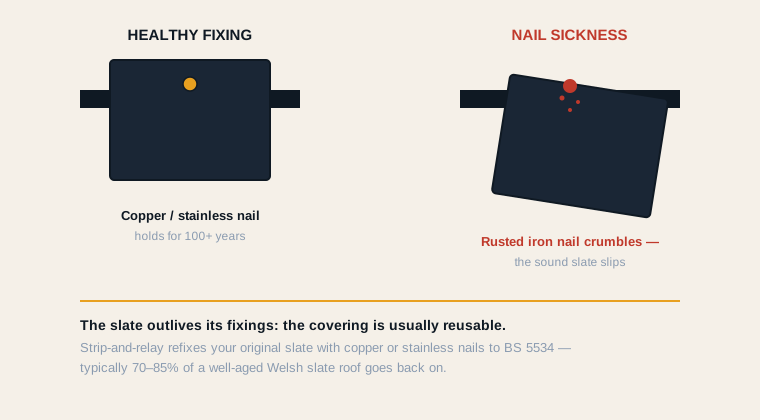
Original Welsh slate on Didcot properties can last 150 years or more — the slate itself rarely fails. The nails corrode first. When we re-roof with new or reclaimed Welsh slate, we use copper or stainless steel nails throughout. Copper nails are traditional and correct for heritage work; both last the lifetime of the slate and eliminate nail sickness as a re-roofing trigger.
Call 0186 580 3181 to book a free survey in Didcot. No call-out fee and a written quote before work starts.
Typical Costs in Didcot
Indicative costs for Didcot properties. All jobs are surveyed and quoted in writing.
Replace 1–5 slates (matched Welsh)£200–£500
Replace 5–20 slates (matched)£400–£900
Full re-roof, 3-bed semi (Welsh slate)£10,000–£16,000
Full re-roof, Edwardian villa (Welsh slate)£14,000–£22,000
Stone slate repair (Cotswold)£300–£800
Stone slate re-roof (cottage)£12,000–£22,000+
Free survey & written quote
No call-out fee. We survey and quote before any work starts.
Slate in Didcot is the historic covering on the older and larger houses around the terraces near the station and Ladygrove; the failure is almost always nail sickness — the fixings corroding — rather than the slate itself, so we refix or strip-and-relay, reusing sound original slate wherever we can and matching new where we cannot.
Correct grade, thickness and colour matched on every repair job.
02
Copper Fixings
Copper or stainless steel nails throughout — no nail sickness recurrence.
03
Heritage Experience
Listed building and conservation area slate work carried out regularly.
04
10-Year Guarantee
All slate work covered by our written 10-year workmanship guarantee.
Didcot's slate is on its Victorian railway heritage — the terraces that went up near the station and engine sheds when the town was a railway junction, largely modest two-storey houses roofed in Welsh slate. A century on, these are classic nail-sickness roofs: sound slate slipping because the fixings have corroded. Didcot sits on open Vale gravels below the Downs in a comparatively dry but exposed setting, and the wind that crosses the flat ground drives rain hard against any gap a slipped slate opens, so we treat slippage on these terraces as a priority before water reaches the timbers. On the narrow-frontage station terraces, pavement scaffold needs a South Oxfordshire permit, which we arrange and itemise. We strip and relay reusing the original slate where it is sound and match new Welsh slate by grade where individual slates have delaminated.
Honest advice
How to Tell You Need Slate Roofing
In Didcot, the roofs we are called to reflect the town's own building character. Didcot grew fast around the railway and power station, so its stock is overwhelmingly Victorian railway terraces near the station giving way to large modern estates at Ladygrove and Great Western Park — slate on the oldest terraces, concrete interlocking across the new build. Didcot sits on the open Vale gravels below the Downs, a comparatively dry, exposed setting where wind-driven rain on the newer estates and slate slippage on the older terraces are the common faults.
Slate in Didcot is the historic covering on the older and larger houses around the terraces near the station and Ladygrove; the failure is almost always nail sickness — the fixings corroding — rather than the slate itself, so we refix or strip-and-relay, reusing sound original slate wherever we can and matching new where we cannot. Where only a few Didcot slates have slipped from isolated nail failure, targeted refixing is enough; a whole slope should be stripped only when nail sickness is genuinely widespread, and we will show you the evidence before recommending it.
Slate is the dominant historic covering on much of North Oxford and the larger Victorian and Edwardian properties. Slate itself outlasts its fixings, so the failure is usually the nails, not the slate.
Individual slates slipping and appearing in the gutter or on the ground
A scatter of gaps across an otherwise sound slate slope
Damp appearing after driven rain rather than steady rain
Delaminating or flaking slates on an exposed slope
A previous repair using the wrong-size or mismatched slate
When it is not the answer: If only a few slates have slipped from isolated nail failure, targeted refixing is enough — a whole slope should only be stripped when nail sickness is genuinely widespread. Read the full guide.
Nail sickness on slate — strip-and-relay refixes original slate to BS 5534.The process
How a Oxford Slate Roofing Job Runs
1. Survey
Every Didcot job follows the same disciplined sequence, adapted to the property — a period roof around the terraces near the station and Ladygrove gets more survey and matching time than a modern estate roof, but the steps are the same.
We assess the slate condition and, crucially, the nails — testing how widespread any nail sickness is across the slope.
2. Written quote
A fixed-price quote for refixing, matched replacement or strip-and-relay, with slate provenance specified for conservation areas.
3. Source matched slate
Where replacement is needed, we source matched Welsh slate by grade and colour before starting.
4. The work
We refix or relay using copper or stainless nails to BS 5534, reusing sound original slate where possible.
5. Sign-off
We clear the site and hand over the 10-year workmanship guarantee.
Timescales
How Long Does It Take?
Job
Typical duration
Refix slipped slates (per area)
2–4 hours
Matched slate replacement (patch)
Half a day to 1 day
Strip-and-relay (per slope)
3–6 days
Full slate re-roof
1.5–3 weeks
Slate work pauses in high wind — handling slate at height in a gust is unsafe; we build weather margin into the programme.
Access
Scaffold, Skips & Street Access
The Victorian terraces near Didcot station have narrow frontages where pavement scaffold needs a South Oxfordshire permit; the Ladygrove and Great Western Park estates are open modern layouts with driveway access for towers.
Slate work needs scaffold for anything beyond a few slipped slates, both for safe access and to stack and sort the slate. Scaffold is specified for: strip-and-relay, re-roofs, and any work beyond refixing a handful of slates - always itemised in your written quote, never a hidden extra, and we arrange it.
Central Oxford's medieval street core and the tight Victorian terraces of Jericho and off the Cowley Road mean rear-access scaffold and permit-controlled pavement space are the norm on many jobs. Pavement scaffold and skip permits go through Oxford City Council; allow a few working days on streets like Holywell Street, Ship Street, St Michael's Street, Merton Street where space is tight.
Access in Didcot splits between the Victorian terraces near the station — narrow frontages where pavement scaffold needs a South Oxfordshire permit — and the open Ladygrove and Great Western Park estates, where driveway room suits tower access. We arrange any permit and itemise the scaffold, so the setup element of a Didcot quote reflects the real access at your property rather than a blanket figure.
Pricing
Oxford Slate Roofing: Cost Guide
Job
Typical range
Notes
Refix slipped slates (per area)
£150–£350
Where isolated
Matched slate replacement (patch)
£350–£800
Sourced to match
Strip-and-relay (per slope)
£2,500–£6,000
Reuses sound slate
Full Welsh slate re-roof
£14,000–£28,000+
Natural slate
Copper/stainless refixing
Included
To BS 5534
What moves the price
Extent of nail sickness across the slope
Proportion of original slate reusable
Scaffold for strip-and-relay and re-roofs
Conservation-grade matched slate where required
Worked example: A strip-and-relay of the front slope on a Victorian terrace in Jericho, reusing around 80% of the original Welsh slate with new stainless fixings, typically runs around £3,800.
Staged payment on strip-and-relay and re-roofs against completed work; materials on site first. VAT included in the written quote.
Covering OX1, OX2, OX3, OX4 and surrounding postcodes.
Guarantee
Your Guarantee, Explained
The same written guarantee applies to every roof we complete in Didcot and the surrounding villages.
Slate work carries a 10-year workmanship guarantee; reclaimed and new Welsh slate itself has a service life measured in generations.
Covered: workmanship for 10 years, in writing, transferable if you sell.
On top: manufacturer warranties on materials (terms vary by product).
Not covered: storm or impact damage - that is an insurance matter, and we will document it for your claim.
If a fault appears in covered work, we come back and put it right. No quibbling, no re-charge.
Good to know
Disruption, Mess & Weather
Scaffold up for larger jobs, careful sorting of slate on site, and a skip for waste — we protect the grounds and keep the site tidy daily. You do not need to stay home for external work - we just need power and access agreed in advance.
Slate work runs through the year in settled weather; on a strip-and-relay we only open what we can make weathertight each day. The Thames and Cherwell valley setting keeps ambient humidity high, so drying times for mortar, GRP and biocide run longer here than on the surrounding higher ground.
Customer Reviews
Slate Roofing Reviews from Didcot
★★★★★
"Full re-roof with new Penrhyn Welsh slate on our Victorian semi. Matched the colour of the original perfectly. The copper nails are a detail you only get from someone who knows their trade."
Anthony H. · Didcot
★★★★★
"Emergency repair after storm damage to our slate roof. Matched replacement slates sourced within 48 hours. Excellent service under pressure."
Elizabeth M. · Didcot area
★★★★★
"Re-roofed our listed Edwardian property with reclaimed Welsh slate. The planners were satisfied, the finish is outstanding. Would not hesitate to recommend."
Roger F. · Old Didcot
Call 0186 580 3181 for a free survey — no call-out fee.
FAQ
Slate Roofing Didcot — Common Questions
Replacing a small number of slates in Didcot costs £200–£900 depending on quantity and access. A full re-roof with Welsh slate on a standard 3-bed semi costs £10,000–£16,000. Larger period properties cost more. Free survey and written quote provided.
Yes. We assess the grade, thickness and colour of existing slate on every survey and source matched material from our slate suppliers. For conservation area and listed properties where specific grade approval is required, we advise on this before ordering.
Correctly installed Welsh slate with copper or stainless fixings lasts 100–150+ years. Original Victorian and Edwardian slate in Didcot is already 100–130 years old and still performing on well-maintained properties. The nails fail before the slate — which is why fixing specification matters.
Yes. We carry out slate roofing on listed buildings across Didcot and Oxfordshire. We advise on Listed Building Consent requirements at the survey stage and work with approved materials and specifications.
Cotswold stone slate is natural limestone split into thin slabs for roofing — found on period properties in Woodstock, Witney and the surrounding Cotswold villages. It is a different material from Welsh slate with its own failure modes (delamination from freeze-thaw cycling) and sourcing requirements. We carry out Cotswold stone slate work across the region.
We use copper or stainless steel nails for all slate roofing work in Didcot. Copper nails are traditional and correct for heritage work; stainless steel provides the same longevity at lower cost. Both materials last the lifetime of the slate. We never use galvanised or ferrous nails on slate roofs.
For replacing a small number of individual slates, scaffold is not always necessary and we assess access requirements on the survey. For re-roofing or significant repair work, scaffold is required and is included in the written quote — never charged as a surprise extra.
Slate roofing in Didcot appears on Victorian and Edwardian properties in the older areas of the town — post-war and 1960s–1970s planned expansion estates. At 100–130 years, original Welsh slate on Didcot properties is typically sound structurally, but the nail fixings have corroded and individual slates have slipped. We assess grade, colour and thickness on every Didcot survey and source matched Penrhyn or Ffestiniog slate for repairs.
Didcot's Conservation Area and Slate Specification
Conservation area properties in Didcot require like-for-like material replacement on street-facing slopes — Welsh slate cannot be replaced with fibre cement or synthetic slate without prior notification to the council, which is unlikely to be approved. We check for every Didcot survey address and specify compliant materials in the written quote.
Nail Specification for Didcot Slate Roofs
We use copper or stainless steel nails for all slate work across Didcot. Original Victorian slate on Didcot properties was fixed with copper nails — a traditional specification that lasts the lifetime of the slate. We never use galvanised or mild steel fixings on slate roofs, which corrode within 30–50 years and create nail sickness on the slate deck.
Free survey in Didcot. Written quote before work starts, no call-out fee. Call 0186 580 3181.
Get In Touch
Free Slate Roofing Quote in Didcot
No call-out fee. Written quote before work starts. Local roofers who know Didcot.