Lead flashing repairs, chimney re-leading, valley relining and parapet gutters across Oxford. The most common cause of Oxford roof leaks, fixed properly — not siliconed over. Free surveys.
Tell us the job in 30 seconds. No pushy sales, no call-out fee.
Quick answer: Lead work in Oxford costs £250–£1,400 for flashings and chimney re-leads, £350–£800 per metre for parapet gutters. We use Code 4 and Code 5 lead to BS EN 12588 with patination oil on period properties. NFRC registered, 10-year guarantee. Free survey. Call 0186 580 3181.
Lead flashing failure is the single most common cause of Oxford roof leaks. The city’s extraordinary density of Victorian and Edwardian housing — with chimney stacks on almost every property in Jericho, North Oxford, Headington, Marston and the historic streets of east Oxford — means thousands of lead junctions are in continuous service, many of them original to the building. The oldest surviving lead work in Oxford’s residential streets is now 120 years old. Most fails significantly between 60 and 100 years, and the majority of properties built before 1939 have lead that now requires assessment.
The physics of failure are straightforward. Lead expands and contracts with temperature by approximately 3mm per metre per 30°C temperature change. Over decades of Oxfordshire winters and summers, this cycling causes the upstand of chimney step flashings to slowly pull away from the raked brickwork joint into which it is dressed. Once the upstand lifts even 1–2mm, capillary action draws water behind it during driving rain, and the leak begins. The correct repair is to rake out the mortar joint, dress the new lead upstand into the joint correctly to the British Standard, and point over with mortar — not silicone, which splits at the lead-to-brick interface within two seasons.
Lead valley relining is the second most common lead job in Oxford. Valley gutters collect all the water running off both sides of a roof valley and channel it to the guttering. Original Code 4 lead valley linings on period Oxford properties develop pinhole fatigue at the bend points and crack along the centreline after prolonged service. Water then tracks beneath the tiles and into the roof void rather than down the valley. The repair is complete valley stripping and relining in new Code 4 or Code 5 lead, with correct welt joints to allow for thermal movement.
Lead work costs in Oxford: Flashing repair (single junction) £250–£500 · Chimney re-lead (full stack) £600–£1,200 · Valley relining £400–£900 · Parapet gutter relining £1,500–£5,000+. Free survey, written quote. Call 0186 580 3181.
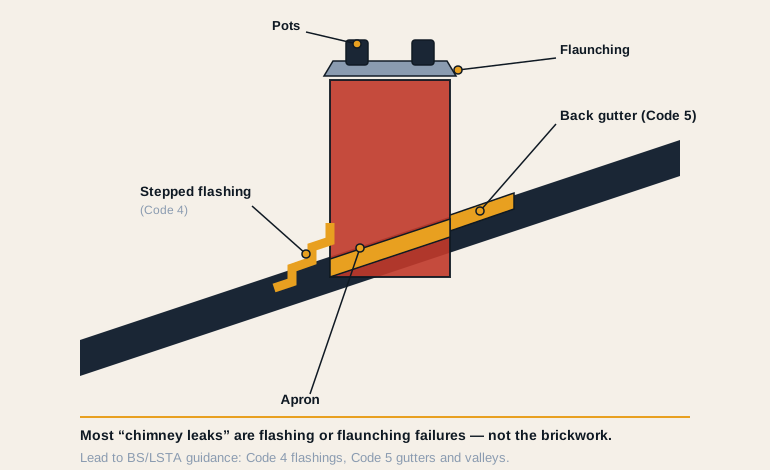
Lead has a high coefficient of thermal expansion. Oxford's four-season climate — cold wet winters and warm dry summers — creates a significant annual temperature differential that causes measurable movement in every lead sheet on every roof in the city. Over 100 years on Oxford's Victorian properties, this cyclical movement works lead upstands away from their mortar joint fixings, opens joints at valley laps, and splits lead that has been over-fixed or incorrectly installed.
The concealed lead-lined parapet gutters on North Oxford's and Summertown's largest Edwardian villas are the most technically demanding lead application in Oxford. Blocked silently, they fail without external visible signs. Water penetrating through a failing parapet gutter tracks through the wall fabric — sometimes for years — before appearing as persistent damp on an interior wall. The cost of making good the internal damage often exceeds the cost of the lead relining itself. We carry out parapet gutter inspections and relining across North Oxford and Summertown.
Silicone applied to failing lead flashings bonds initially but splits within one to two seasons as thermal movement continues. We do not carry out silicone repairs on lead work — the correct repair is re-dressing the lead upstand into a freshly raked mortar joint, or replacing the lead section where it has split or degraded beyond re-dressing.
We specify Code 4 lead (1.8mm) for all flashings and soakers, and Code 5 lead (2.24mm) for valley linings, parapet gutters and flat roof covering — in line with BS EN 12588 and Lead Sheet Association technical guidelines. We never under-specify lead gauge on cost grounds. On period and conservation area properties in Oxford, we apply patination oil to new lead work to promote rapid weathering to a natural grey and prevent carbonate staining on surrounding clay tiles or Welsh slate.
Lead valley linings on Oxford's period properties fail after 50–80 years — the bays open, the clips corrode, and water channels through the lining rather than over it. Valley relining requires stripping the adjacent tile courses, removing the old lead, inspecting the valley board, fitting new Code 5 lead with correct bay lengths and clips, and re-bedding the tile courses. The result is a valley with a 50+ year design life.
We cover Oxford city and all surrounding Oxfordshire towns. Select your area for location-specific information, local pricing and a free survey.
Lead failure is behind a large share of Oxford's period-property leaks. Original Victorian and Edwardian lead at chimneys, valleys and bay tops is now past its service life and pulling away from the masonry.
When it is not the answer: A sound lead flashing with a single lifted edge can sometimes be re-dressed rather than replaced — and silicone over lead is never the right fix, so beware anyone offering it. Read the full guide.
We assess the lead at chimneys, valleys, bays and abutments, and identify what has failed and why.
A fixed-price quote specifying the lead code and detail, with conservation matching noted where required.
Booked to suit access; leadwork on a period property is planned around dry weather for a proper finish.
We form and dress the lead to traditional detail with correct bay lengths and movement joints, and patination oil to prevent staining.
We clear the site and hand over the 10-year workmanship guarantee.
| Job | Typical duration |
|---|---|
| Single flashing junction | Half a day |
| Full chimney re-lead | 1–2 days |
| Valley re-line (per valley) | 1–2 days |
| Bay window top re-lead | 1 day |
Leadwork needs dry conditions to dress and seal properly; we schedule around Oxford's wetter spells rather than rush a compromised finish.
Leadwork at chimneys and valleys needs safe standing time, so scaffold is usual; low bay-window leadwork can sometimes be reached from a tower. Scaffold is specified for: chimney, valley and abutment leadwork where safe standing access at height is essential - always itemised in your written quote, never a hidden extra, and we arrange it.
Central Oxford's medieval street core and the tight Victorian terraces of Jericho and off the Cowley Road mean rear-access scaffold and permit-controlled pavement space are the norm on many jobs. Pavement scaffold and skip permits go through Oxford City Council; allow a few working days on streets like Holywell Street, Ship Street, St Michael's Street, Merton Street where space is tight.
| Job | Typical range | Notes |
|---|---|---|
| Single flashing junction | £280–£550 | Code 4–5 lead |
| Full chimney re-lead | £450–£900 | All abutments |
| Valley re-line (per valley) | £550–£1,200 | Traditional detail |
| Bay window top re-lead | £450–£850 | Period bay |
| Lead ridge / hip (per m) | £70–£130 | Where specified |
Worked example: Re-leading the valley on an Edwardian property in North Oxford, including scaffold and traditional bay-length detailing, typically runs around £950.
Staged payment on scaffold-based leadwork; materials on site first. VAT included in the written quote.
Covering OX1, OX2, OX3, OX4 and surrounding postcodes.
Leadwork carries a 10-year written workmanship guarantee; correctly dressed Code 4–5 lead should itself last decades.
If a fault appears in covered work, we come back and put it right. No quibbling, no re-charge.
Scaffold to the work area and some quiet, skilled hand-work — minimal mess, and we clear and check the finish before leaving. You do not need to stay home for external work - we just need power and access agreed in advance.
Leadwork runs year-round in dry spells; Oxford's valley humidity means we pick settled windows for the best patination and seal. The Thames and Cherwell valley setting keeps ambient humidity high, so drying times for mortar, GRP and biocide run longer here than on the surrounding higher ground.
“Lead flashing on two chimney stacks had failed completely — both were tracking water into the roof space. Full re-lead on both stacks in one day. Properly dressed into the brick joints, not pointed over silicone. The right way to do it.”
“Parapet gutter on our terraced property in Jericho had been leaking into the first floor bedroom for months. They traced the exact failure in the lead lining, ripped out the failed section and relined it properly. Dry since. Should have called them first.”
“Valley relining on our Headington Edwardian semi. Previous roofer had just pushed the old lead back and siliconed it — failed within a season. Proper new Code 4 lead, fully dressed. Done correctly this time.”
Lead flashing repairs on Oxford period properties typically cost £250–£700 depending on the location and extent. A full chimney re-lead including back gutter, step flashings and soakers is usually £500–£1,200. Parapet gutter relining on a large North Oxford villa can cost £2,000–£5,000+. All work quoted free in writing.
Original lead work on Victorian and Edwardian Oxford properties is now 80–130 years old. Lead oxidises and becomes brittle over time, and the thermal expansion cycling of a Oxfordshire winter causes the lead upstand to pull away from brickwork joints. Once the seal breaks, water tracks behind the chimney stack or parapet and into the ceiling void. Silicone is not an appropriate repair — correctly re-dressed lead is the only durable fix.
Lead Code refers to thickness: Code 3 (1.32mm) is used for soakers, Code 4 (1.80mm) for chimney step flashings and valley linings, Code 5 (2.24mm) for parapet gutters and flat roof details. Oxford's older housing frequently has Code 3 and Code 4 in original applications. Where we replace, we match or upgrade the code to the current British Standard for the application.
Yes. Parapet gutters are common on the large Victorian and Edwardian villas of North Oxford and on some terraced properties in Jericho. These lead-lined gutters run behind parapet walls and are completely hidden from view. Failure is only evident when water breaks through the ceiling below. We inspect, repair and reline parapet gutters correctly.
Lead flashing repair at a chimney junction costs £250–£500. Full chimney re-leads cost £600–£1,200. Valley relining costs £400–£900. All Oxford lead work is quoted free and in writing. Call 0186 580 3181.
Lead flashings fail primarily through thermal cycling — the lead expands and contracts with temperature changes and eventually pulls away from the mortar joint. Oxford's Victorian and Edwardian chimneys with original lead are now 80–130 years old. We re-dress or replace to the correct Code 4 or Code 5 specification.
Yes. We carry out lead work on listed buildings and conservation area properties throughout Oxford and the surrounding villages. We use traditional lead techniques and appropriate gauges for heritage properties.
Lead flashings, valley relining, parapet gutters. The most common Oxford roof leak, fixed properly. Free written quotes.
0186 580 3181