Real re-roofing prices for Oxford properties, broken down by material, property era and conservation area status. Free survey and written quote with no call-out fee.
Quick answer: A new roof in Oxford costs £5,500–£8,500 for a concrete tile semi, £7,500–£13,000 for clay tile, and £10,000–£28,000+ for Welsh slate on Edwardian properties. Conservation area material requirements and roof complexity are the main cost drivers. All quotes include scaffold and a 10-year guarantee.
✓ NFRC Registered
✓ Fully Insured
✓ 10-Year Guarantee
✓ Free Quotes
✓ No Hidden Costs
What You Get
What a Full Re-Roof Includes
A complete re-roof on an Oxford property is a strip-and-recover: the existing tiles or slates are removed to rafter level, the timber structure is inspected, new breathable membrane and pressure-treated battens are fitted, and new covering is laid with correct fixings, ridges, valleys and flashings. Every quote from us includes scaffold, materials, labour, waste disposal and our 10-year written guarantee.
Domestic re-roofing of an existing property usually qualifies for the reduced 5% VAT rate rather than standard 20% — we confirm this in writing before work begins. The four variables that actually move an Oxford quote are roof area and pitch, covering material, scaffold access, and whether the timbers underneath are sound.
Oxford Cost Drivers
What Makes Oxford Roofs Cost More — or Less
Conservation Area Premium (+20–40%)
Oxford has more conservation area coverage than most UK cities. Properties in Jericho, the North Oxford Victorian Suburb, Old Headington, Iffley village and Woodstock require matched clay plain tile or Welsh slate on street-facing slopes — materials that cost two to three times more per square metre than concrete interlocking tile. Sourcing reclaimed clay to match an existing property also adds lead time.
Property Era and Complexity
A North Oxford Edwardian villa with four chimney stacks, lead-lined valleys, a parapet gutter and 250m² of Welsh slate is a fundamentally different job from a 1960s Blackbird Leys semi with a simple dual-pitch concrete roof. Era predicts Oxford roofing cost more reliably than floor area.
Access and Oxford City Centre Constraints
Terraced streets in Jericho and central Oxford, and properties on narrow lanes in the older village cores, sometimes require alternative scaffold solutions or a skip permit from Oxford City Council. We account for access at the survey stage — it is never a surprise added later.
Worked Example: Blackbird Leys 3-Bed Semi
A standard 1960s three-bed semi on the Blackbird Leys estate, roughly 75m² of concrete interlocking tile, re-roofed with stainless steel fixings: £5,500–£8,000 all-in including scaffold, strip, disposal, new membrane and battens, new tiles and the 10-year guarantee. The same property in clay plain tile (if desired, though not required outside a conservation area) would run £7,500–£11,000.
One further Oxford-specific cost factor is the university and college property market's influence on local trades demand: spring and summer see heavy competition for skilled roofers as colleges and HMO landlords schedule works around the academic year. Booking a re-roof in the autumn or winter window often secures better scheduling and avoids the peak-season premium that some Oxford contractors apply between May and September.
Large Edwardian villa, Welsh slate£15,000–£28,000+
Chimney re-flash (per stack, add)£250–£600
Timber repairs (if found, add)£500–£2,000
Prices include scaffold, strip-off, disposal, new breathable membrane, new battens, covering, ridge and verge work. Per square metre, Oxford concrete tile runs roughly £85–£170/m², clay £110–£210/m², and natural slate £140–£280/m² — the upper end reflecting Oxford's position in the higher-cost South East.
Understanding Your Oxford Re-Roof Quote
How to Read and Compare Quotes
Two re-roofing quotes for the same Oxford property can differ by thousands of pounds while looking superficially similar. The difference is almost always in what each includes. A genuine quote itemises the covering material and grade, the membrane and battens, scaffold, strip-off and disposal, any allowance for timber repair, VAT treatment, and the guarantee. A cheaper-looking quote often omits scaffold as a line item, specifies a lower tile grade, or excludes waste disposal — costs that reappear later. When comparing Oxford re-roof quotes, insist that each specifies the same material and scope so you are comparing like for like. The single biggest lever on the final bill is the covering you choose to put back on. On a non-conservation Oxford property you have a genuine choice between concrete tile at the economical end and clay or slate at the premium end. On a conservation area property the choice is constrained — the material must match the original, which usually means clay plain tile or Welsh slate at the higher price points. This is why two identical-sized Oxford semis, one in Blackbird Leys and one in a Jericho conservation street, can carry re-roof quotes that differ by fifty per cent or more. Timber condition is the main source of genuine mid-job cost variation. Until the old covering is stripped, no roofer can see the full state of the rafters, battens and decking. On Oxford's older stock, decades of minor water ingress sometimes leave rot that only becomes visible once the roof is open. A professional roofer flags likely timber work at the survey and gives you an allowance, so a discovery on the day is not a shock. We itemise a timber allowance in every re-roof quote and only charge for what is actually needed, with photographs of anything replaced.
Domestic re-roofing of an existing property usually qualifies for the reduced 5% VAT rate rather than the standard 20%, a saving worth confirming in writing before work begins.— Source: HMRC VAT Notice 708
The Re-Roofing Process, Step by Step
What Happens During Your Oxford Re-Roof
Knowing what a re-roof actually involves removes much of the anxiety around the cost, because it shows where the money goes. The job begins with scaffold, erected to give safe working access to every slope and to protect the areas below — a legal requirement and a genuine cost, which is why it appears as a line in any honest quote. Once the scaffold is up, the existing covering is stripped: tiles or slates removed, old battens and membrane taken off, and the whole lot cleared to a skip or grab lorry. This is the point at which the roof structure becomes visible for the first time. With the roof open, we inspect the rafters, wall plates and any decking for rot or insect damage. On Oxford's older properties this is where the timber allowance in the quote is either used or returned — sound timbers mean no extra cost, while any rot found is photographed, shown to you, and replaced before we go further. New breathable membrane is then laid, which manages any condensation and provides a secondary barrier, followed by new pressure-treated battens set to the correct gauge for the covering. The new covering goes on from the eaves up: tiles or slates fixed with the correct stainless steel nails or clips, ridges and hips bedded or mechanically fixed, valleys lined in Code 5 lead, and all abutments and chimneys flashed in lead. Verges are finished with mechanical dry verge to the current standard. The roof is made weathertight at the end of each working day, so your Oxford home is never left exposed overnight. On completion we strike the scaffold, clear the site, and issue the written ten-year guarantee. A typical three-bed Oxford semi runs three to four working days start to finish.
Comparing Quotes
How to Read an Oxford Re-Roof Quote
It is also worth understanding how Oxford quotes are structured so you can compare like with like. Two quotes that look similar on the surface can differ by thousands once you read what each includes. Check specifically for scaffold (a genuine line item, never an optional extra), waste disposal and skip permits, whether new breathable membrane and treated battens are priced in, the fixing specification (stainless steel throughout, not galvanised), ridge and verge method (dry-fix systems versus mortar bedding), and any allowance for timber repairs once the covering is stripped. A quote that omits these is not cheaper — it has simply moved the cost to a mid-job variation. Our written Oxford quotes itemise every element so there is nothing to add later.
Want an accurate figure for your specific Oxford property? Book a free survey and written quote.
"Full re-roof on our 1930s semi. Clear written quote, scaffold included, no surprises. The clay tiles they matched look perfect against the neighbours."
Sarah T. · Summertown
★★★★★
"Re-roofed our Blackbird Leys semi after years of slipped tiles. Stainless fixings, 10-year guarantee, done in three days. Fair price for the area."
Dave M. · Blackbird Leys
★★★★★
"Welsh slate re-roof on our North Oxford villa. They understood the conservation requirements and sourced matched Penrhyn slate. Faultless."
Eleanor H. · North Oxford
Common Questions
Frequently Asked Questions
A new roof in Oxford costs £5,500–£8,500 for a concrete tile semi, £7,500–£13,000 for clay, and £10,000–£28,000+ for Welsh slate on larger Edwardian properties. All our quotes include scaffold and a 10-year guarantee.
Conservation areas such as Jericho and North Oxford require matched clay plain tile or Welsh slate on street-facing slopes. These materials cost two to three times more per square metre than concrete tile, and reclaimed matching adds sourcing time.
Yes. Scaffold is included as a line item in every written quote for re-roofs and significant repair work. Safe access is a legal requirement for working at height — if a quote does not show scaffold, ask why.
Re-roofing an existing residential property usually qualifies for the reduced 5% VAT rate rather than standard 20%. We confirm the applicable rate in writing before any work begins.
A standard three-bed Oxford semi takes 3–4 working days: scaffold and strip on day one, deck inspection and battens, then re-covering and ridge work. The roof is made weathertight at the end of every working day.
We never quote a re-roof without a physical survey. Roof area, pitch, timber condition, access and conservation requirements all affect the price and can only be assessed on site. The survey is free with no obligation.
The most common additions are timber repairs discovered once the covering is stripped (£500–£2,000), chimney re-flashing (£250–£600 per stack), and skip permits on restricted streets. We flag likely timber work at the survey stage so there are no surprises.
A full re-roof is a major spend, and an honest roofer will tell you when you do not yet need one. It becomes the right call when repairs stop holding or the covering has reached the end of its service life across the whole roof.
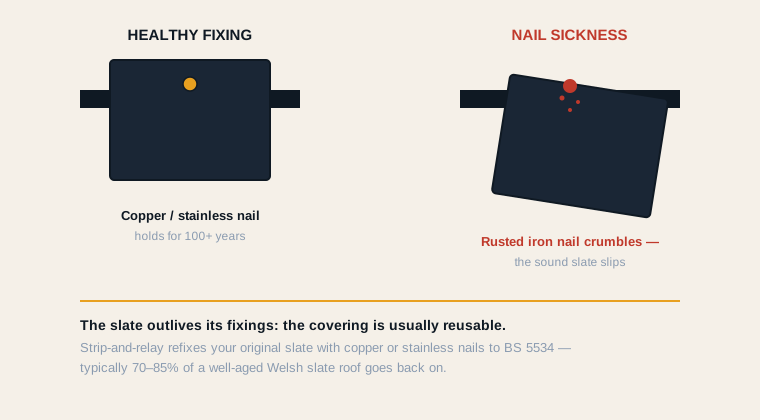
Tiles lifting by hand across the roof (widespread nail sickness)
Repeated leaks appearing in different places after each repair
Sagging or dipping in the roof line seen from the street
Widespread slipped or delaminating slates on a Victorian or Edwardian property
A covering visibly past its age — brittle concrete tile, crumbling mortar throughout
When it is not the answer: If the failure is contained to one slope or a single area, a targeted repair is far cheaper — do not let anyone sell you a full re-roof for an isolated problem. Read the full guide.
Nail sickness: the slate outlives its fixings, so the covering is often reusable.The process
How a Oxford Roof Replacement Job Runs
1. Survey & measure
We measure the roof, assess the timbers and confirm material requirements — including any conservation matching for your Oxford property.
2. Written itemised quote
A fixed-price quote covering scaffold, strip, disposal, membrane, battens, covering and the guarantee, with VAT status confirmed in writing.
3. Scheduling & materials
We schedule the re-roof, typically within 2–4 weeks, allowing lead time for matched clay or slate where a conservation area requires it.
4. Scaffold & strip
Scaffold goes up, the old covering is stripped to the timbers, and the deck is inspected before anything new is laid.
5. Re-cover & sign-off
New membrane, battens and covering are laid with stainless fixings; we clear all waste and issue the 10-year guarantee.
Timescales
How Long Does It Take?
Job
Typical duration
2-bed terrace re-roof
3–4 days
3-bed semi re-roof
5–8 days
Detached / larger property
1–2 weeks
Welsh slate re-roof (period property)
1.5–3 weeks
Timber repairs (if found)
Add 1–2 days
Sustained rain or high wind pauses a strip-off; we only open up what we can make weathertight by the end of the working day.
Access
Scaffold, Skips & Street Access
A full re-roof always needs scaffold for safe access and to move materials — it is included as a line item in the quote. Scaffold is specified for: the whole job — a re-roof is never done without full scaffold - always itemised in your written quote, never a hidden extra, and we arrange it.
Central Oxford's medieval street core and the tight Victorian terraces of Jericho and off the Cowley Road mean rear-access scaffold and permit-controlled pavement space are the norm on many jobs. Pavement scaffold and skip permits go through Oxford City Council; allow a few working days on streets like Holywell Street, Ship Street, St Michael's Street, Merton Street where space is tight.
Pricing
Oxford Roof Replacement: Cost Guide
Job
Typical range
Notes
2-bed terrace re-roof
£5,500–£8,500
Concrete or clay, incl. scaffold
3-bed semi re-roof
£8,000–£13,000
Covering-dependent
Detached / larger property
£12,000–£20,000+
Size & material driven
Welsh slate re-roof (period)
£14,000–£28,000+
Matched natural slate
Timber / structural repairs
£300–£1,500
If found on strip
What moves the price
Roof size, pitch and number of slopes
Covering: concrete tile, clay, or natural slate
Scaffold scale and duration
Conservation constraints on materials in Oxford's protected areas
Condition of timbers found once stripped
Worked example: A full concrete-tile re-roof on a 3-bed semi in Cowley, including scaffold, strip, new membrane, battens and covering, typically lands around £10,500.
Staged payments on re-roofs against completed work — never a large sum before materials are on site. Written fixed-price quote with VAT stated.
Covering OX1, OX2, OX3, OX4 and surrounding postcodes.
Guarantee
Your Guarantee, Explained
The full re-roof carries a 10-year written workmanship guarantee; the covering and membrane carry their own manufacturer warranties, often 15–30 years, on top.
Covered: workmanship for 10 years, in writing, transferable if you sell.
On top: manufacturer warranties on materials (terms vary by product).
Not covered: storm or impact damage - that is an insurance matter, and we will document it for your claim.
If a fault appears in covered work, we come back and put it right. No quibbling, no re-charge.
Good to know
Disruption, Mess & Weather
A re-roof means scaffold up for the duration, some noise during strip and nailing, and a skip on site — we protect the garden and drive and keep the site tidy daily. You do not need to stay home for external work - we just need power and access agreed in advance.
Re-roofs run through most of the year; we schedule strip-offs around settled-weather windows and never leave a roof open overnight. The Thames and Cherwell valley setting keeps ambient humidity high, so drying times for mortar, GRP and biocide run longer here than on the surrounding higher ground.
Get Your Free Oxford Re-Roof Quote
Free survey, written quote, no call-out fee. Covering Oxford and all of Oxfordshire.