Transparent roof repair prices for Oxford properties, from single tile replacement to full chimney re-leads. Free survey, written quote, no call-out fee.
Quick answer: Roof repairs in Oxford cost £150–£900 for most jobs: tile replacement £150–£450, ridge repointing £350–£650, lead flashing repair £250–£500, and full chimney re-leads £600–£1,400. The exact figure depends on access, materials and whether conservation area matching is required.
✓ NFRC Registered
✓ Fully Insured
✓ 10-Year Guarantee
✓ Free Quotes
✓ No Hidden Costs
What's Covered
Common Oxford Roof Repairs
Roof repairs cover any work short of a full re-roof: replacing cracked or slipped tiles, re-bedding loose ridge tiles, re-dressing or replacing failed lead flashings, relining valleys, repointing chimney stacks and clearing or refixing displaced ridge lines. Most Oxford repairs are single-day jobs. The cost is driven by access, the materials required, and whether the property is in a conservation area needing matched clay tile or Welsh slate.
The most common repair call across Oxford is lead flashing failure at chimney stacks — original Victorian and Edwardian lead is now 100–130 years old and past its service life. The second most common is ridge mortar failure on 1930s semis.
Oxford Repair Patterns
What Oxford Properties Need Repaired
Period Property Lead Work
Victorian terraces in Jericho and off the Cowley Road, and Edwardian villas in North Oxford and Summertown, generate constant lead flashing repair demand. Original lead at chimney stacks and valleys has been thermally cycling for over a century and pulls away from mortar joints. Repairs on conservation area properties require lead re-dressed to Code 4 with patination oil to prevent staining on the surrounding clay tile or slate.
1930s Ridge Mortar
The 1930s semis of Headington, Cowley and Kidlington have ridge mortar beds now 85–90 years old. Repointing a full ridge run costs £350–£650 and is a straightforward day's work — the most common single repair on Oxford's inter-war stock.
Post-War Estate Tile Slip
On the Blackbird Leys, Barton and Risinghurst estates, nail sickness causes individual tile slip on 1960s–1970s concrete roofs. Isolated repairs cost £150–£280, but where slip is widespread, a survey will advise whether repair or re-tiling is the more sensible spend.
Access in Central Oxford
Repairs on terraced streets in Jericho or the city centre sometimes need a skip or scaffold permit from Oxford City Council, which we arrange. On most two-storey Oxford semis, tower or ladder access keeps repair costs at the lower end of the range.
Oxford Prices
Roof Repair Cost by Job Type
Single/few tile replacement (concrete)£150–£280
Tile replacement (clay, matched)£200–£450
Ridge repointing (full run)£350–£650
Lead flashing repair (one junction)£250–£500
Full chimney re-lead£600–£1,400
Valley relining (per 3m)£400–£800
Slipped ridge tile re-bed£150–£350
Emergency make-safe call-outfrom £180
Repair costs assume standard two-storey access. Conservation area material matching, restricted-access streets and scaffold requirements can move a repair to the upper end. We give a fixed written price after a free survey — no call-out fee and no charge for the quote.
When to Repair and When to Replace
Making the Right Call for Your Oxford Roof
The most valuable thing a roofer can tell you is when not to spend money. Not every problem needs a full re-roof, and not every ageing roof needs replacing today. On an Oxford property, the repair-or-replace decision turns on how widespread the failure is. Isolated slipped tiles, a single failed flashing, or a length of eroded ridge mortar are repairs — often single-day jobs that buy the roof another decade or more. Widespread tile slip across the whole deck, recurring leaks in different places, or a covering visibly at the end of its life point towards replacement. On Oxford's post-war estates, this decision comes down to nail sickness. Where fewer than roughly fifteen per cent of tiles show movement, targeted repair is the sensible spend. Where the ferrous nails have corroded across the whole roof — as they have on most 1960s Blackbird Leys, Barton and Risinghurst properties — repeated repairs become a false economy, and re-tiling with stainless fixings is the better long-term value. We test tile movement across the deck at the survey and tell you honestly which side of that line your roof sits on. On period Oxford properties the calculation is different. A Victorian or Edwardian roof with sound clay tiles or Welsh slate can often be kept going almost indefinitely with lead and mortar maintenance — the tiles themselves outlast several generations of fixings and flashings. Here the honest answer is usually repair, not replacement, even on a hundred-year-old roof. We would rather re-lead a chimney and repoint a ridge on a sound Jericho terrace than sell an unnecessary re-roof. That honesty is why much of our work comes from repeat customers and recommendations.
Working at height on any Oxford roof is governed by the Work at Height Regulations 2005, which require safe access such as scaffold or a tower for anything beyond a short-duration low-risk task.— Source: HSE Work at Height Regulations 2005
How We Diagnose an Oxford Roof Leak
Finding the Real Source of the Water
The hardest part of many roof repairs is not the fixing but the finding. Water rarely enters directly above where it appears inside; it tracks along battens, rafters and felt before dripping through a ceiling, so the internal stain can be metres from the actual defect. A roofer who simply patches the area above the stain often misses the real source, and the leak returns. Our diagnosis starts in the loft, where we trace the water back to its entry point along the timbers, then moves to the roof itself to identify the specific failed element — a cracked tile, a failed flashing, an eroded mortar joint, a split valley. Oxford's varied housing stock each has characteristic leak sources we know to check. On Victorian and Edwardian properties, the usual culprits are aged lead at chimneys and valleys, and slipped or delaminated slates. On 1930s semis, it is failed ridge mortar and lead flashing at the chimney. On post-war estate properties, it is nail-sick slipped tiles and, on any property with an extension, the junction between the main roof and the flat or lower roof. Knowing the failure patterns of each Oxford era means we look in the right place first rather than working by trial and error. Once the source is confirmed, the repair itself is usually straightforward and the cost predictable. What matters is that we fix the actual defect, not just the symptom, and that we check for any related issues while we have access — a chimney that needs re-leading often has flaunching or pointing that will fail next, and dealing with both in one visit saves a second scaffold cost later. We give you a fixed written price for the diagnosed work, carry it out with matched materials where conservation requires, and back it with our ten-year guarantee. An honest diagnosis is the foundation of a repair that actually lasts.
Not sure what your roof needs? Book a free survey and get a fixed written repair quote.
"Chimney flashing had been leaking for months. They found it in ten minutes, re-leaded it properly, and the ceiling stain has gone. £420 well spent."
Michael R. · Jericho
★★★★★
"Ridge tiles had come loose after a storm. Repointed the whole run in a day for a fair price. No call-out fee, proper written quote."
Janet P. · Headington
★★★★★
"Slipped tiles on our Barton semi kept letting water in. Honest advice that repair would do for now rather than pushing a full re-roof. Refreshing."
Tom B. · Barton
Common Questions
Frequently Asked Questions
Most Oxford roof repairs cost £150–£900. Tile replacement runs £150–£450, ridge repointing £350–£650, lead flashing repair £250–£500, and full chimney re-leads £600–£1,400. We give a fixed written price after a free survey.
No. We never charge a call-out fee for a survey or quote. You get a written fixed-price quote with no obligation to proceed. For emergency make-safe work, the call-out is included in the repair cost.
Conservation area properties in Oxford require lead re-dressed to the correct code with patination oil to prevent staining on surrounding clay tile or slate. The material specification and the care required push these repairs above a standard flashing job.
If damage is isolated and the covering is otherwise sound, repair is far cheaper. Where slip or failure is widespread across the whole deck — common on Oxford's post-war estates — re-tiling becomes the more cost-effective choice over time. A free survey will advise honestly.
Scheduled repairs are typically booked within 5–10 working days. For emergencies with active water ingress, we aim to be on site within 2–4 hours anywhere in Oxford and Oxfordshire to apply a temporary make-safe.
Lead flashing failure at chimney stacks is the single most common repair on Oxford's Victorian and Edwardian properties, where original lead is now 100–130 years old. Ridge mortar failure on 1930s semis is the second most common.
Yes. We repair conservation area properties throughout Oxford using matched reclaimed clay tile, matched Welsh slate and correctly specified lead. We check conservation status at every survey and confirm compliant materials in the written quote.
Most Oxford roof problems announce themselves indoors before they are visible outside — a damp patch, a dripping loft, or debris in the gutter. The question is whether it is a contained repair or the first sign of a covering at the end of its life.
A damp patch on an upstairs ceiling that darkens after rain
Daylight or wet timber visible in the loft
Slipped, cracked or missing tiles seen from the ground
Debris from the roof (mortar, tile fragments) in the gutters or on the drive
Staining down a chimney breast or near a valley
When it is not the answer: If more than about a third of the covering has slipped or the whole roof lifts tile-by-tile from nail sickness, repairing piece-by-piece is money wasted — re-roofing is the better long-term value. Read the full guide.
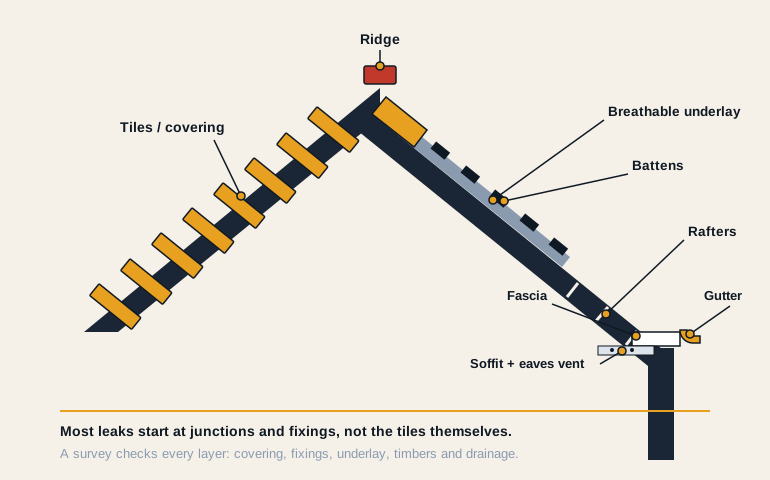
The layers of a pitched roof — most leaks start at junctions and fixings, not the tiles.The process
How a Oxford Roof Repairs Job Runs
1. Survey & diagnosis
We inspect the roof and the loft to find the true source — water often tracks metres from the entry point on Oxford's older long-rafter roofs. No call-out fee.
2. Written itemised quote
You get a fixed-price written quote naming the materials and the exact scope, with scaffold or access itemised, not a vague verbal figure.
3. Scheduling
Scheduled repairs are usually booked within 5–10 working days; active leaks are prioritised for same-day make-safe.
4. The repair
We carry out the repair with matched materials where conservation compliance requires it, and protect the area below.
5. Cleanup & sign-off
We clear all debris, water-test where relevant, and hand over the written 10-year workmanship guarantee.
Timescales
How Long Does It Take?
Job
Typical duration
Slipped or cracked tile replacement
1–2 hours
Ridge re-bed or repoint (per run)
Half a day to 1 day
Lead flashing repair (one junction)
Half a day
Rear valley rebuild
2–3 days
Full chimney re-lead
1–2 days
Wet or high-wind days pause tiling and leadwork — we build weather margin into every Oxford booking and make the roof safe at the end of each day.
Access
Scaffold, Skips & Street Access
Most Oxford repairs run from towers or roof ladders; scaffold is quoted only where the job needs safe standing time at height. Scaffold is specified for: chimney-side repairs, full valley rebuilds, and anything beyond a day working at height - always itemised in your written quote, never a hidden extra, and we arrange it.
Central Oxford's medieval street core and the tight Victorian terraces of Jericho and off the Cowley Road mean rear-access scaffold and permit-controlled pavement space are the norm on many jobs. Pavement scaffold and skip permits go through Oxford City Council; allow a few working days on streets like Holywell Street, Ship Street, St Michael's Street, Merton Street where space is tight.
Pricing
Oxford Roof Repairs: Cost Guide
Job
Typical range
Notes
Slipped or cracked tile refix
£150–£280
Per visit incl. access
Ridge re-bed / repoint (per m)
£60–£110
Lime mortar on period stacks
Lead flashing repair (one junction)
£280–£550
Code 4–5 lead
Rear valley rebuild
£550–£1,200
Depends on length & access
Chimney re-lead
£450–£900
Per stack
What moves the price
Roof height, pitch and access difficulty
Scaffold versus tower or ladder access
Conservation-area material matching (clay, slate, lime mortar)
Extent hidden until the area is opened up
Worked example: A rear valley rebuild on a 1930s semi in Summertown, including tower access and waste removal, typically runs around £680.
No deposit on repairs under £500. Staged payments on larger jobs — nothing up front before materials are on site. VAT included in every written quote.
Covering OX1, OX2, OX3, OX4 and surrounding postcodes.
Guarantee
Your Guarantee, Explained
Workmanship on the repaired section is covered for 10 years in writing; any replacement tiles, slates or lead carry their manufacturer warranties on top.
Covered: workmanship for 10 years, in writing, transferable if you sell.
On top: manufacturer warranties on materials (terms vary by product).
Not covered: storm or impact damage - that is an insurance matter, and we will document it for your claim.
If a fault appears in covered work, we come back and put it right. No quibbling, no re-charge.
Good to know
Disruption, Mess & Weather
A day of ladder or tower work and a small amount of tile debris — we sheet below the work area and clear everything before we leave. You do not need to stay home for external work - we just need power and access agreed in advance.
Repairs run year-round; temporary weatherproofing goes on the same day if rain stops work mid-job. The Thames and Cherwell valley setting keeps ambient humidity high, so drying times for mortar, GRP and biocide run longer here than on the surrounding higher ground.
Get Your Free Oxford Roof Repair Quote
Free survey, written quote, no call-out fee. Covering Oxford and all of Oxfordshire.