Clay plain tiles, Welsh slate matching, concrete interlocking and period tile sourcing across Oxford. Expert re-tiling for Victorian terraces, Edwardian villas and modern estates. Free written quotes.
Tell us the job in 30 seconds. No pushy sales, no call-out fee.
Quick answer: Roof tiling in Oxford covers clay and concrete tile repair from £150 and full re-tiling from £5,500 with stainless steel fixings. We match reclaimed clay tiles for conservation areas. NFRC registered, fully insured, 10-year guarantee. Free survey with no call-out fee. Call 0186 580 3181.
Oxford’s housing stock spans more tile types per square mile than almost any city outside London. The Victorian and Edwardian terraces of Jericho, Holywell Street, Marston and Headington were built with hand-made clay plain tiles — typically 10.5” x 6.5” with a double-camber profile that produces the distinctive ripple of aged Oxford roofscapes. These tiles require matching by size, camber, surface texture and fired colour when individual replacements are needed. Getting this wrong is immediately visible and fails conservation area requirements in protected streets.
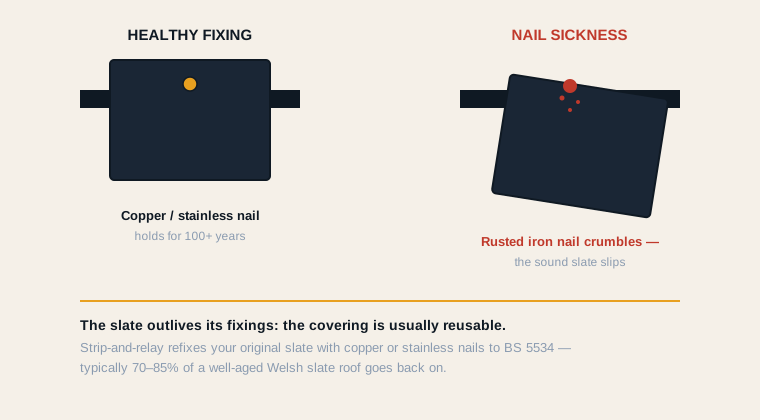
The 1930s semi-detached expansion of Oxford introduced machine-made clay tiles and the first concrete interlocking tiles. Properties across Cowley, Rose Hill, Marston and the early Headington estates used these materials, which are now 80–90 years old. Nail sickness — where original ferrous nail fixings corrode and allow tiles to slip down the roof — is the dominant failure mode on this era of housing. A full re-tile on a 1930s semi involves stripping to the rafters, inspecting and treating any timber decay, laying breathable underlay, pressure-treating new battens, and re-tiling in matched clay or quality concrete.
The post-war and 1960s–1970s estates of Blackbird Leys, Barton, Littlemore and Risinghurst are dominated by concrete interlocking tiles now reaching 50–60 years. These are heavier than clay, and when nail sickness takes hold across a deck the cumulative load from slipped tiles is a structural risk. Re-tiling in this era means sourcing a modern concrete interlocking tile with a compatible interlock geometry to ensure correct lap and weathering.
Oxford roof tiling costs: Partial re-tile (rear slope, 3-bed semi) £1,800–£3,500 · Full re-tile (3-bed semi, concrete interlocking) £3,500–£6,500 · Clay plain tile re-tile (period property) £5,000–£9,000+. Free written survey. Call 0186 580 3181.
We inspect the existing tile condition, batten and underlay, and identify any timber decay. Written report provided same day.
For period properties we source or bring tile samples for your approval before ordering. Conservation area compliance confirmed.
Properly erected scaffold, full strip to rafters, old materials removed from site. Structure inspected before proceeding.
New underlay, treated battens, tiling. Ridge and hip pointed in correct mortar mix. 10-year written guarantee on completion.
Clay plain tiles on Oxford's Victorian and Edwardian properties are typically in excellent structural condition at 100–130 years — clay lasts 150 years or more when correctly laid and maintained. The failure points are the lime mortar ridge beds (failing at 80–100 years), the nail fixings (original cut nails corroding after 80+ years in the exposed positions), and the lead flashings at chimney stacks and valleys. Tile replacement is needed only where individual tiles have cracked or delaminated.
Concrete interlocking tiles dominate Oxford's post-war estate stock. At 50–70 years, ferrous nail fixings on these properties are corroding and tiles are slipping — nail sickness is systemic rather than isolated. Targeted repair addresses individual displaced tiles but does not solve the underlying nail failure. Full re-tiling with stainless steel fixings eliminates nail sickness and carries our 10-year guarantee.
Repair work on Oxford's conservation area properties — Jericho, North Oxford Victorian Suburb, Old Headington, Iffley village — must use matched clay plain tiles. This requires sourcing reclaimed tile of the correct size, fired colour and camber from specialist suppliers. We maintain relationships with reclaimed tile suppliers and carry out colour and dimension assessment on every survey where matching is required.
Ridge tile bedding failure is the most common tiling maintenance call across Oxford's 1930s and post-war housing stock. Original mortar beds are now 80–90 years old on 1930s properties and failing progressively. Ridge tiles rock in wind, and loose ridge tiles are a winter storm risk — both as a tile displacement hazard and as a water ingress source. Full ridge repointing on a standard Oxford semi costs £350–£650 and is a straightforward one-day job.
Modern ridge and verge systems use mechanical fixings rather than mortar — eliminating mortar failure as a future maintenance requirement. Where a full re-roof is being carried out, dry ridge and dry verge systems are worth considering for the long-term maintenance benefit. On conservation area properties, we advise on whether dry systems are appropriate for the character of the property and the street.
We cover Oxford city and all surrounding Oxfordshire towns. Select your area for location-specific information, local pricing and a free survey.
A full re-roof is a major spend, and an honest roofer will tell you when you do not yet need one. It becomes the right call when repairs stop holding or the covering has reached the end of its service life across the whole roof.
When it is not the answer: If the failure is contained to one slope or a single area, a targeted repair is far cheaper — do not let anyone sell you a full re-roof for an isolated problem. Read the full guide.
We measure the roof, assess the timbers and confirm material requirements — including any conservation matching for your Oxford property.
A fixed-price quote covering scaffold, strip, disposal, membrane, battens, covering and the guarantee, with VAT status confirmed in writing.
We schedule the re-roof, typically within 2–4 weeks, allowing lead time for matched clay or slate where a conservation area requires it.
Scaffold goes up, the old covering is stripped to the timbers, and the deck is inspected before anything new is laid.
New membrane, battens and covering are laid with stainless fixings; we clear all waste and issue the 10-year guarantee.
| Job | Typical duration |
|---|---|
| 2-bed terrace re-roof | 3–4 days |
| 3-bed semi re-roof | 5–8 days |
| Detached / larger property | 1–2 weeks |
| Welsh slate re-roof (period property) | 1.5–3 weeks |
| Timber repairs (if found) | Add 1–2 days |
Sustained rain or high wind pauses a strip-off; we only open up what we can make weathertight by the end of the working day.
A full re-roof always needs scaffold for safe access and to move materials — it is included as a line item in the quote. Scaffold is specified for: the whole job — a re-roof is never done without full scaffold - always itemised in your written quote, never a hidden extra, and we arrange it.
Central Oxford's medieval street core and the tight Victorian terraces of Jericho and off the Cowley Road mean rear-access scaffold and permit-controlled pavement space are the norm on many jobs. Pavement scaffold and skip permits go through Oxford City Council; allow a few working days on streets like Holywell Street, Ship Street, St Michael's Street, Merton Street where space is tight.
| Job | Typical range | Notes |
|---|---|---|
| 2-bed terrace re-roof | £5,500–£8,500 | Concrete or clay, incl. scaffold |
| 3-bed semi re-roof | £8,000–£13,000 | Covering-dependent |
| Detached / larger property | £12,000–£20,000+ | Size & material driven |
| Welsh slate re-roof (period) | £14,000–£28,000+ | Matched natural slate |
| Timber / structural repairs | £300–£1,500 | If found on strip |
Worked example: A full concrete-tile re-roof on a 3-bed semi in Cowley, including scaffold, strip, new membrane, battens and covering, typically lands around £10,500.
Staged payments on re-roofs against completed work — never a large sum before materials are on site. Written fixed-price quote with VAT stated.
Covering OX1, OX2, OX3, OX4 and surrounding postcodes.
The full re-roof carries a 10-year written workmanship guarantee; the covering and membrane carry their own manufacturer warranties, often 15–30 years, on top.
If a fault appears in covered work, we come back and put it right. No quibbling, no re-charge.
A re-roof means scaffold up for the duration, some noise during strip and nailing, and a skip on site — we protect the garden and drive and keep the site tidy daily. You do not need to stay home for external work - we just need power and access agreed in advance.
Re-roofs run through most of the year; we schedule strip-offs around settled-weather windows and never leave a roof open overnight. The Thames and Cherwell valley setting keeps ambient humidity high, so drying times for mortar, GRP and biocide run longer here than on the surrounding higher ground.
“Full clay tile replacement on our Edwardian villa in North Oxford. They matched the original plain tiles perfectly — you genuinely cannot tell which section was replaced. Exceptional attention to detail.”
“Tiling repair on our Jericho terrace after a section of tiles were disturbed during neighbour's building work. They sourced matching reclaimed tiles and blended the repair invisibly. Exactly what the conservation area required.”
“Had three quotes for re-tiling our 1930s semi in Headington. These were the only ones who actually checked the battens and underlay before quoting. Ended up needing new battens in two sections — glad it was picked up.”
Re-tiling a standard 3-bed semi in Oxford costs £3,500–£7,000 depending on tile type. Clay plain tile replacements on period properties in Jericho or North Oxford cost more due to material sourcing and matching. Full re-tiling quotes are provided free and in writing after a survey.
Yes. We hold and source reclaimed clay plain tiles in the sizes, cambers and surface profiles used across Jericho, central Oxford and Headington. We bring samples to the survey so you can approve the match before any work is ordered.
Clay plain tiles dominate Oxford's Victorian and Edwardian housing stock — they're hand-made, lighter, and age gracefully. Concrete interlocking tiles became standard from the 1930s onward and are heavier, cheaper to install, and longer lasting when first fitted. After 40–60 years, concrete tiles develop nail sickness and surface erosion. Clay tiles correctly maintained will outlast a building.
Yes. Many streets in central Oxford, Jericho and North Oxford carry conservation area restrictions that specify tile type, colour, profile and surface texture. We advise on compliant materials on every survey and can help identify whether planning notification is required before work begins.
We work with all tile types found across Oxford's housing stock: clay plain tiles (Victorian and Edwardian properties), Welsh slate (North Oxford villas), concrete interlocking (post-war estates) and Cotswold stone slate (surrounding villages). Conservation area matching is our speciality.
Yes. Many Oxford conservation area properties require matched clay plain tiles for repairs. We source reclaimed tiles to match the specific size, camber and fired colour of existing stock. This takes more effort but ensures repairs are invisible and planning-compliant.
Re-tiling a standard 3-bed semi with concrete interlocking tiles costs £5,500–£8,500. Clay plain tiles cost more — typically £7,500–£12,000 for the same property. Free written quotes. Call 0186 580 3181.
Clay plain tiles, concrete interlocking, period matching. Free written survey. 10-year guarantee.
0186 580 3181